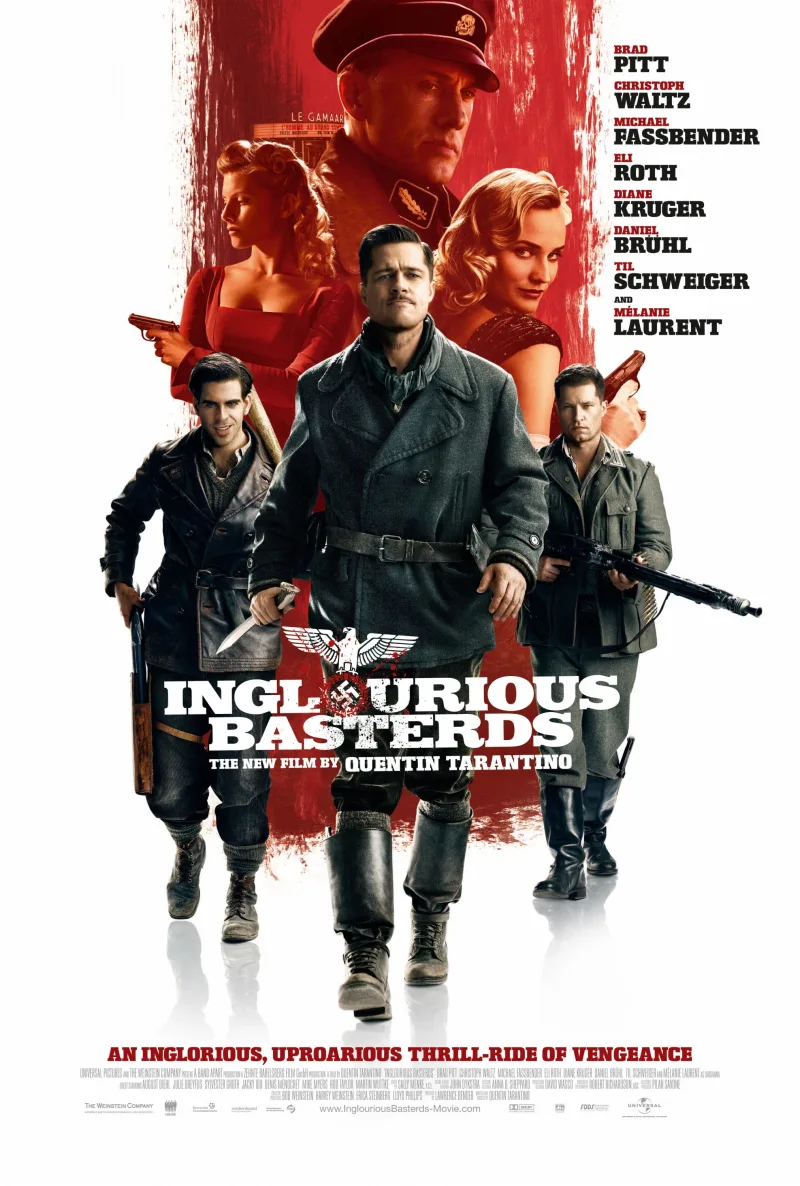
Inglourious Basterds
Darkly comic, suspenseful, operatic, and audaciously revisionist — oscillating between excruciating tension and irreverent humor, with an undercurrent of righteous fury
Based on a publicly circulated draft of this screenplay sourced online — it may differ from the official shooting script or final film. Shown to demonstrate ProofIntelligence.
During World War II, a Jewish cinema owner in Paris and a squad of Jewish-American soldiers independently plot to assassinate the Nazi High Command at a film premiere, while a cunning SS officer plays all sides for his own survival.
Executive Summary
This is a masterfully constructed World War II revenge fantasy that operates simultaneously as a suspense thriller, a dark comedy, and a love letter to cinema. The screenplay's greatest asset is its dialogue — the farmhouse interrogation, the strudel scene, and the tavern standoff are among the finest suspense sequences written in the last twenty years, built entirely through conversation and subtext. Col. Hans Landa is one of the great screen villains, and the role alone will attract A-list talent. The parallel structure — Shosanna's personal revenge and the Basterds' military operation converging on a single explosive night — provides both intimate emotional stakes and epic scope. The multilingual texture is a genuine innovation that enhances rather than limits international appeal. Investment considerations: the period European setting and large ensemble demand a high budget (₹100Cr+ equivalent), but the dialogue-driven set-pieces are cost-efficient, and the high-concept premise guarantees marketing traction. The screenplay is complete, polished, and ready for packaging. Primary development note: deepening the individual Basterds beyond Aldo and Donny would strengthen the emotional payoff of the climax. This is a prestige genre film with massive commercial crossover potential — the kind of project that generates awards conversation, cultural impact, and long-tail streaming revenue.
Why this verdict
This is Quentin Tarantino's "Inglourious Basterds," a masterfully constructed World War II revenge fantasy that operates as both a genre-bending thriller and a love letter to cinema itself. Its core strength is the extraordinary tension architecture — the opening farmhouse interrogation and the La Louisiane tavern sequence are among the finest suspense scenes written in the last two decades, built entirely through dialogue, subtext, and the audience's awareness of hidden information. The character of Col. Hans Landa is one of the great screen villains: charming, terrifying, and unpredictable in equal measure. The screenplay's five-chapter structure is unconventional but purposeful, weaving parallel revenge plots that converge in a spectacular climax. The dialogue is exceptional — each character has a distinct voice, and the multilingual texture (French, German, English, Italian) is used as both a narrative device and a source of tension. Areas that could be noted: the Basterds themselves, beyond Aldo and Donny, remain somewhat thin as characters; the tonal shifts between graphic violence and dark comedy are deliberate but may challenge some audiences; and the literary narrator device, while effective, occasionally pulls the reader out of pure cinematic storytelling. In the market, this sits as a prestige genre film with massive crossover appeal — a war film that is really about the power of cinema, revenge, and identity, with the kind of set-piece writing that attracts A-list talent and generates awards conversation.
What we read
Inglourious Basterds is a five-chapter World War II revenge fantasy that braids two independent assassination plots — one by a Jewish cinema owner, one by a squad of Jewish-American commandos — into a single explosive climax at a Nazi film premiere in occupied Paris. The central dramatic question is whether Shosanna Dreyfus and the Basterds can destroy the Nazi High Command before the cunning SS Colonel Hans Landa outmaneuvers them all. What makes the screenplay extraordinary is its tension architecture: scenes like the opening farmhouse interrogation and the basement tavern card game are built almost entirely from dialogue, subtext, and dramatic irony, creating unbearable suspense without a single gunshot. The best thing in it is the character of Landa himself — a villain who is simultaneously the most charming and most terrifying person in every room, whose final gambit to switch sides transforms him from antagonist to wild card, only for Aldo's final act to deny him the clean escape he engineered.
Score Breakdown
Craft Scores
Weighted craft score
The strudel scene (pp. 68-72) generates more tension through conversation than most screenplays achieve with gunfire. Every major character has a distinct voice — Landa's elaborate courtesy, Aldo's Tennessee drawl, Shosanna's guarded terseness. The multilingual texture is structural, not decorative. The three-finger mistake (p. 107, explained on p. 121) is a brilliant example of language as plot device. Band: ProofScript Masterpiece. One band up: some of the narrator passages could be converted to dramatized scenes, trusting the audience more.
The farmhouse interrogation (pp. 3-19) is a masterclass in scene construction — 17 pages of dialogue that build from pastoral calm to massacre without a single wasted line. The five-chapter structure is unconventional but purposeful, creating natural rhythm shifts and allowing each section its own tonal identity. The convergence of parallel plotlines in the climax is executed with precision. Band: ProofScript Elite. One band up: tighter integration of the Basterds' storyline with Shosanna's in the second act — they operate almost independently until the premiere, which slightly weakens the structural unity.
The Dreyfus massacre (p. 18) is devastating; the strudel scene (pp. 68-72) generates visceral terror through subtext alone — the urine puddle reveal is one of the most emotionally powerful details in modern screenwriting. The Shosanna-Fredrick mutual killing (pp. 158-159) is genuinely tragic. The cinema's destruction delivers cathartic triumph. Band: ProofScript Elite. One band up: if the individual Basterds had personal scenes like Donny's Mrs. Himmelstein moment, their deaths would carry more emotional weight.
The screenplay's central theme — that identity cannot be hidden or escaped — is carried through every major beat: Shosanna's false identity, the Basterds' disguises, Landa's attempt to shed his Nazi past, and the swastika carvings that ensure permanent marking. Cinema itself becomes a thematic vehicle — the weapon of vengeance is literally a film projection. The ending perfectly resolves the theme: Aldo's carving ensures Landa can never take off his 'uniform.' Band: ProofScript Elite. One band up: the Basterds' thematic contribution could be deepened — their Jewish identity is stated but rarely explored beyond Donny's backstory.
Col. Landa (pp. 5-19, 65-72, 129-150, 163-166) is one of the great screen villains — multilingual, charming, terrifying, and ultimately self-serving. Shosanna's arc from hunted child to avenging angel is powerful and complete. The Fredrick-Shosanna relationship adds genuine poignancy. Band: ProofScript Elite. One band up: deeper characterization of the individual Basterds beyond Aldo and Donny — Wicki, Stiglitz, and Hirschberg remain functional rather than fully realized.
The screenplay is written with extraordinary confidence and skill. Scene descriptions are vivid and purposeful, dialogue formatting is clean, and the prose style — while occasionally indulgent with directorial asides and editorial commentary — adds personality rather than clutter. The multilingual dialogue is handled with clarity. Camera directions are present but generally serve the storytelling. Band: ProofScript Elite. One band up: trimming the directorial commentary and camera directions would bring the craft closer to pure screenplay form, though the personality of the writing is part of its appeal.
Market Scores
Weighted market score
'A Jewish cinema owner and a squad of Jewish-American soldiers independently plot to assassinate Hitler at a Nazi film premiere in occupied Paris' — this is one of the most compelling high-concept premises in modern cinema. It combines revenge fantasy, alternate history, and meta-cinematic commentary in a single, instantly pitchable idea. Band: ProofScript Masterpiece. One band up: the concept is essentially perfect as stated.
The screenplay reinvents the war film genre through its audacious alternate history, its use of cinema as both weapon and theme, its multilingual structure, and its tonal fusion of suspense, dark comedy, and operatic revenge. The five-chapter structure, the literary narrator, and the meta-cinematic climax (a film within a film destroying the audience watching it) are genuinely innovative. Band: ProofScript Masterpiece. One band up: some individual elements (the revenge fantasy, the ensemble war film) are familiar — it's the combination and execution that make them feel new.
The Dreyfus massacre (p. 18) is devastating; the strudel scene (pp. 68-72) generates visceral terror through subtext alone — the urine puddle reveal is one of the most emotionally powerful details in modern screenwriting. The Shosanna-Fredrick mutual killing (pp. 158-159) is genuinely tragic. The cinema's destruction delivers cathartic triumph. Band: ProofScript Elite. One band up: if the individual Basterds had personal scenes like Donny's Mrs. Himmelstein moment, their deaths would carry more emotional weight.
The screenplay combines prestige auteur filmmaking with commercial genre entertainment — a rare sweet spot. The ensemble cast structure attracts multiple A-list attachments. The high-concept premise is instantly marketable. The dialogue-driven set-pieces are cost-efficient relative to their impact. The multilingual element enhances international appeal. Band: ProofScript Elite. One band up: the graphic violence and extended dialogue scenes narrow the audience somewhat; a slightly more accessible entry point could broaden commercial reach without sacrificing artistic integrity.
Casting
Christoph Waltz
as COL. LANDA
Waltz possesses the rare combination of multilingual fluency (German, French, English), theatrical charm, and the ability to shift from warmth to menace within a single line. His background in European theater gives him the precision and stamina required for the screenplay's extended dialogue sequences.
Brad Pitt
as LT. ALDO
Pitt brings natural charisma, comic timing, and a physicality that grounds Aldo's larger-than-life persona. His ability to play folksy intelligence — smart men who present as simple — is exactly what the Tennessee lieutenant requires.
Mélanie Laurent
as SHOSANNA
Laurent has the combination of vulnerability and fierce determination that Shosanna demands, plus native French fluency essential for the role. Her expressive face can convey the terror of the strudel scene and the resolve of the projection booth climax without dialogue.
Eli Roth
as DONNY
Roth's intense physical presence and natural aggression suit the Bear Jew's intimidating persona. His background as a horror filmmaker gives him an instinctive understanding of the role's tonal balance between dark comedy and genuine menace.
Daniel Brühl
as FREDRICK
Brühl excels at playing intelligent, sensitive men with hidden depths — his ability to make Fredrick both genuinely likeable and ultimately dangerous is crucial to the character's tragic function. His German-Spanish background gives him the multilingual facility the role requires.
Diane Kruger
as BRIDGET
Kruger is a German-born actress with genuine glamour and the ability to project both sophistication and toughness. Her fluency in German, French, and English mirrors the character's multilingual world perfectly.
August Diehl
as MAJOR HELLSTROM
Diehl has the sharp, angular intensity and quiet menace that Hellstrom requires — a man who can make a card game feel like an interrogation. His German theater background gives him the discipline for the role's extended dialogue sequences.
Jacky Ido
as MARCEL
Ido brings warmth and quiet strength to Marcel, grounding the character's devotion to Shosanna in genuine tenderness. His French-African background gives him authentic presence in the occupied Paris setting.
Pacing & Rhythm
Overall pace
Deliberately varied — extended slow-burn dialogue sequences punctuated by explosive violence, building to a rapid-fire climactic convergence
The pacing follows a distinctive Tarantino pattern: extended slow-burn sequences that build unbearable tension, punctuated by explosive releases of violence. This creates a rhythm that is more like breathing than a steady acceleration — inhale (tension), exhale (violence), inhale again. The screenplay's willingness to let scenes run long (the farmhouse interrogation, the tavern card game) is its greatest pacing strength, not a weakness — these extended sequences are where the screenplay does its best work. The third act accelerates dramatically through intercutting, creating a symphonic finale that pays off every thread simultaneously. The pacing is unconventional but masterfully controlled.
SLOW · pp. 40–55
Shosanna's early Paris life and Fredrick's courtship — necessary character building but the slowest stretch in the screenplay
Fix: The Fredrick-Shosanna bistro scene could be tightened by 2-3 pages without losing its charm or essential information
SLOW · pp. 78–85
Operation Kino briefing — expository scene that, while entertaining, delivers information that could be more economical
Fix: The Churchill/Fenech scene is witty but could be compressed; some of the film criticism discussion is indulgent
RUSHED · pp. 140–142
Aldo's capture and transport happen very quickly — the shift from the premiere to the tavern negotiation is abrupt
Fix: A brief beat showing Aldo's reaction to being captured — his defiance or calculation — would smooth the transition
RUSHED · pp. 163–166
The epilogue moves quickly from the war's end to the final carving — the emotional weight of the victory could breathe more
Fix: A moment acknowledging the cost — Shosanna, Marcel, Donny, the fallen Basterds — before the final scene would deepen the ending
Conflict Escalation
The conflict escalation follows a brilliant wave pattern rather than a simple ascending line. The screenplay builds to explosive peaks (farmhouse massacre, tavern shootout, cinema destruction) with deliberate valleys between them that allow tension to reset before building again. Each chapter has its own internal escalation curve, and the overall trajectory moves from personal threat (one family) to global stakes (the entire Nazi leadership). The tavern sequence is the screenplay's most sustained escalation — nearly 20 pages of steadily mounting tension that explodes into chaos. The final act intercuts multiple escalating threads simultaneously, creating a symphonic crescendo.
Peak moment · page 162
The cinema explodes — Shosanna's giant face delivers her message of vengeance, Marcel ignites the nitrate film, bombs detonate, and the entire Nazi High Command is destroyed in a conflagration of fire and cinema
Protagonist Arc
The protagonist arc tracks two parallel journeys: Shosanna's transformation from terrified survivor to avenging angel, and Aldo's steady moral force that bookends the film. Shosanna's arc is the more dramatic — she descends to absolute rock bottom (family massacre, strudel terror) before rising to her moment of triumph, even though she dies achieving it. Her arc is tragic and triumphant simultaneously: she gets her revenge but pays with her life. Aldo's arc is flatter but serves a different function — he is the moral constant, the man who ensures that evil cannot hide behind a deal. The dual-protagonist structure means the overall arc has two emotional registers: Shosanna's operatic tragedy and Aldo's darkly comic justice.
Scene Audit
53 scenes evaluated — tension, pacing contribution, and whether each earns its place.
| Pg | Scene | Purpose | Tension | Verdict |
|---|---|---|---|---|
| 3 | EXT—DAIRY FARM—DAY PERRIER · JULIE · CHARLOTTE | Establishes setting, introduces Perrier LaPadite family, creates dread as Nazi convoy approachesMasterful slow-burn opening that establishes tone and world | 25decelerates | essential |
| 5 | INT—LAPADITE FARMHOUSE—DAY COL. LANDA · PERRIER · CHARLOTTE | The farmhouse interrogation — Landa manipulates Perrier into revealing the Dreyfuses, culminating in the massacreOne of the greatest suspense scenes in modern cinema — 15 pages of pure dialogue tension | 85maintains | essential |
| 12 | EXT—DAIRY FARM—DAY CHARLOTTE | Brief cutaway showing the family outside, unaware of the interrogation's stakesEffective tension release and dramatic irony — the daughters don't know what's happening | 40decelerates | essential |
| 18 | UNDERNEATH THE FLOORBOARDS SHOSANNA · COL. LANDA | Massacre of the Dreyfus family and Shosanna's escape — the inciting incidentDevastating payoff to the extended interrogation — Shosanna's escape launches the entire plot | 95accelerates | essential |
| 19 | EXT—DAIRY FARM—DAY COL. LANDA | Nazi convoy departs after the massacreBrief transition that closes the chapter | 30decelerates | essential |
| 20 | EXT—NAZI TOWN CAR (MOVING)—DAY COL. LANDA | Landa explains why he let Shosanna escape — reveals his arrogance and underestimationCrucial character beat — Landa's casual dismissal of Shosanna's survival will be his undoing | 20decelerates | essential |
| 21 | EXT—SOMEWHERE IN ENGLAND—DAY LT. ALDO | Aldo recruits the Basterds — establishes the second plotline and its missionIconic recruitment speech that defines Aldo's character and the Basterds' purpose | 40accelerates | essential |
| 22 | EXT—MOUNTAIN TOP CHALET—DAY / INT—BERCHTESGADEN—DAY HITLER | Hitler rages about the Basterds — establishes their effectiveness and the Bear Jew legendEstablishes stakes from the enemy's perspective — the Basterds are working | 50accelerates | essential |
| 25 | EXT—FRENCH WOODS—DAY LT. ALDO · DONNY · UTIVICH · HIRSCHBERG | Basterds scalp dead Germans, interrogate prisoners — Butz narratesEstablishes the Basterds' methods and introduces the scalping/carving motifs | 55maintains | essential |
| 27 | EXT—FRENCH WOODS—DAY (Basterd Circle) LT. ALDO · DONNY · STIGLITZ · WICKI | Werner Rachtman's interrogation and the Bear Jew's introductionBuilds to the Bear Jew reveal — narrator device works well here for mythic quality | 65accelerates | essential |
| 29 | EXT—FRENCH COUNTRYSIDE—DAY LT. ALDO · STIGLITZ | Flashback — Basterds rescue Stiglitz from prison convoyEconomical backstory that establishes Stiglitz's legend and the Basterds' reach | 50accelerates | essential |
| 32 | INT—BARBER SHOP (BOSTON)—DAY DONNY | Donny's backstory — his motivation for joining the war against GermanyGives Donny personal stakes and cultural specificity — Boston Jewish identity | 20decelerates | essential |
| 33 | INT—SPORTING GOODS STORE—DAY DONNY | Donny acquires his baseball bat — the weapon that will define himCharming scene that transforms the bat from weapon to symbol | 15decelerates | essential |
| 34 | INT—HALLWAY APARTMENT BUILDING—DAY / INT—MRS. HIMMELSTEIN'S APARTMENT—DAY DONNY | Mrs. Himmelstein signs Donny's bat — the bat becomes a community's weapon of vengeanceThe emotional heart of Donny's character — transforms violence into communal act of resistance | 20decelerates | essential |
| 37 | EXT—FRENCH WOODS—DAY (Bear Jew kills Werner) DONNY · LT. ALDO · HIRSCHBERG | Donny beats Werner to death — the Bear Jew legend made realBrutal payoff that delivers on the buildup — intercut with Mrs. Himmelstein adds emotional weight | 75accelerates | essential |
| 38 | INT—BERCHTESGADEN—DAY (Hitler and Butz) HITLER | Butz reports to Hitler — reveals the swastika carving, Basterds' signatureEstablishes the carving motif that will bookend the film | 45maintains | essential |
| 40 | INT—CINEMA AUDITORIUM—NIGHT SHOSANNA | Introduces Shosanna in Paris two weeks after the massacre; she stays behind alone after a German filmElegant transition: Shosanna has survived and found refuge in cinema | 15decelerates | essential |
| 41 | EXT—LITTLE CINEMA (PARIS)—NIGHT / INT—AUDITORIUM SHOSANNA · MADAME MIMIEUX | Shosanna meets Madame Mimieux — the mentor who will shape her lifeEstablishes the cinema as sanctuary and Madame Mimieux as crucial influence | 20decelerates | essential |
| 44 | INT—CINEMA (1944 PARIS)—DAY SHOSANNA | Montage of Shosanna's life as projectionist — three years compressedLyrical sequence that shows Shosanna's mastery of cinema — skills she'll weaponize later | 10maintains | essential |
| 45 | EXT—CINEMA—NIGHT (Marquee) SHOSANNA · FREDRICK | Fredrick Zoller first approaches Shosanna — the fateful meetingCharming meet-cute with sinister undertones — a German soldier courting a hidden Jew | 25maintains | essential |
| 48 | EXT—ROOFTOP CINEMA—NIGHT SHOSANNA · MARCEL · MADAME MIMIEUX | Shosanna smokes on the roof, remembers Madame Mimieux's warning about firePlants the nitrate film flammability — Chekhov's gun for the entire climax | 15decelerates | essential |
| 50 | INT—FRENCH BISTRO—AFTERNOON SHOSANNA · FREDRICK | Fredrick reveals his identity as a war hero and film star — Shosanna learns the stakesKey information scene — Fredrick's connection to Goebbels makes him both dangerous and useful | 30maintains | essential |
| 55 | EXT—CINEMA MARQUEE—DAY SHOSANNA · MAJOR HELLSTROM | Gestapo major takes Shosanna to Maxim's — she fears arrestEffective misdirection — audience fears the worst before the lunch reveal | 55accelerates | essential |
| 57 | EXT/INT—MAXIM'S (FAMOUS PARIS CAFÉ)—DAY SHOSANNA · FREDRICK · GOEBBELS · FRANCESCA · MAJOR HELLSTROM · COL. LANDA | Goebbels lunch — premiere venue changed to Shosanna's cinema, Landa reappearsMultiple plot threads converge — premiere plan, Landa's return, Fredrick's infatuation | 70maintains | essential |
| 68 | EXT/INT—MAXIM'S (strudel scene) SHOSANNA · COL. LANDA | Landa interrogates Shosanna over strudel — the midpoint confrontationMasterpiece of subtext — every line carries double meaning, culminating in the urine reveal | 90decelerates | essential |
| 73 | INT—CINEMA AUDITORIUM—NIGHT (Lucky Kids screening) SHOSANNA · GOEBBELS · FREDRICK · COL. LANDA · FRANCESCA · MAJOR HELLSTROM | Private screening for Goebbels — Shosanna conceives her plan to burn the cinemaThe birth of Shosanna's revenge plan — narrator device effectively conveys her inner revelation | 40maintains | essential |
| 75 | INT—CINEMA LOBBY—NIGHT (post-screening) SHOSANNA · MARCEL | Shosanna tells Marcel her plan to burn the cinema with Nazis insideThe commitment scene — Shosanna and Marcel become co-conspirators in vengeance | 45maintains | essential |
| 78 | INT—ENGLISH COUNTRY ESTATE—DAY LT. HICOX | Operation Kino briefing — Churchill, Fenech, and Hicox plan the assassinationWitty exposition scene that establishes the parallel Allied plot | 30maintains | essential |
| 85 | EXT—CINEMA ROOFTOP—DAY SHOSANNA · MARCEL | Shosanna and Marcel make their film — the message for the NazisMeta-cinematic moment — using filmmaking as a weapon of war | 25maintains | essential |
| 86 | INT—CINEMA (lobby stairs, color) SHOSANNA · MARCEL | Shosanna and Marcel discuss developing the film — the practical challenges of their planReveals the ruthlessness required — they must threaten Gaspar to get the film processed | 35maintains | essential |
| 87 | INT—SMALL FILM-PROCESSING LAB—LATE NIGHT SHOSANNA · MARCEL | Shosanna and Marcel force Gaspar to develop their film at hatchet-pointEffective but tonally jarring — Shosanna's cruelty here is underexplored in its moral implications | 50accelerates | needs_work |
| 88 | INT—PROJECTION ROOM SHOSANNA | Shosanna splices her film into Reel 4 of Nation's PridePrecise, procedural scene that builds anticipation for the climax | 30maintains | essential |
| 88 | EXT—LA LOUISIANE (TAVERN)—NIGHT LT. ALDO · LT. HICOX · WICKI · DONNY · HIRSCHBERG · UTIVICH · STIGLITZ | Establishing the tavern rendezvous location — Aldo objects to the basementPlants the 'fighting in a basement' concern that will prove prophetic | 35maintains | essential |
| 92 | INT—LA LOUISIANE (BASEMENT TAVERN)—NIGHT BRIDGET · LT. HICOX · WICKI · STIGLITZ · MAJOR HELLSTROM | The tavern sequence — card game, Hellstrom's suspicion, escalating standoff, and massacreExtended masterpiece sequence — 20 pages of escalating tension through dialogue and games | 85maintains | essential |
| 110 | INT—LA LOUISIANE—NIGHT (shootout) BRIDGET · WICKI · STIGLITZ · MAJOR HELLSTROM | The tavern erupts in gunfire — most participants killedExplosive payoff to the extended buildup — chaotic, brutal, and devastating | 98accelerates | essential |
| 111 | INT—LA LOUISIANE—NIGHT (aftermath/negotiation) LT. ALDO · BRIDGET · WILLI | Aldo negotiates with Willi for Bridget's release — Bridget kills WilliTense negotiation that ends with Bridget's ruthless pragmatism | 75maintains | essential |
| 116 | INT—FRENCH HOUSE IN COUNTRY (BEDROOM) / INT—DOCTOR'S EXAMINING ROOM—NIGHT DONNY · BRIDGET | Basterds find a veterinarian to treat Bridget's gunshot woundDark comedy that pushes too far with the dog-shooting — effective but tonally excessive | 40maintains | needs_work |
| 118 | INT—LA LOUISIANE—NIGHT (Landa investigation) COL. LANDA | Landa investigates the tavern aftermath — discovers Bridget's shoeBrilliant detective work — the shoe becomes the key evidence, Cinderella inverted | 50maintains | essential |
| 120 | INT—EXAMINING ROOM—NIGHT LT. ALDO · BRIDGET · DONNY · HIRSCHBERG · UTIVICH | Aldo interrogates Bridget — learns about Hitler's attendance and improvises new planCrucial pivot scene — the stakes escalate enormously with Hitler's attendance | 55maintains | essential |
| 127 | INT—SHOSANNA AND MARCEL'S LIVING QUARTERS—NIGHT SHOSANNA | Shosanna prepares for the premiere — dresses, arms herself, point of no returnPowerful visual transformation — Shosanna becomes an avenging angel | 50accelerates | essential |
| 128 | INT—PROJECTION BOOTH—NIGHT SHOSANNA · MARCEL | Shosanna and Marcel review the plan one final timeLast intimate moment between the lovers — tender and devastating | 55maintains | essential |
| 129 | INT—CINEMA LOBBY—NIGHT COL. LANDA · BRIDGET · LT. ALDO · DONNY · HIRSCHBERG · SHOSANNA | The premiere begins — Nazi elite arrive, Landa greets Bridget and the disguised BasterdsAll plotlines converge in one location — the tension is extraordinary | 70accelerates | essential |
| 137 | INT—SHOSANNA'S OFFICE—NIGHT COL. LANDA · BRIDGET | Landa fits the shoe on Bridget — her cover is blown, he strangles herDevastating Cinderella inversion — the shoe fits, and the princess dies | 90accelerates | essential |
| 140 | INT—LOBBY—NIGHT LT. ALDO | Aldo is captured by Nazi guards — his bomb is confiscatedSwift, shocking reversal — Landa has been playing everyone | 80accelerates | essential |
| 141 | EXT—CINEMA—NIGHT / EXT TRUCK (MOVING)—NIGHT / INT—TRUCK (MOVING)—NIGHT LT. ALDO · UTIVICH | Aldo and Utivich are hooded and transported — touching moment between themHumanizing beat amid the chaos — Aldo comforts the crying Utivich | 45decelerates | essential |
| 142 | INT—COUNTRY TAVERN—NIGHT COL. LANDA · LT. ALDO · UTIVICH | Landa reveals his master plan — negotiates his surrender in exchange for allowing the assassinationThe screenplay's most audacious twist — the villain becomes the kingmaker | 75maintains | essential |
| 147 | INT—CINEMA AUDITORIUM—NIGHT (premiere screening) SHOSANNA · MARCEL · DONNY · HIRSCHBERG · HITLER · GOEBBELS | The film begins — intercutting between the screening, Shosanna in the booth, Marcel behind the screen, and Landa's dealMasterful intercutting that builds to the climax — multiple timelines converging | 70accelerates | essential |
| 151 | INT—PROJECTION BOOTH—NIGHT / INT—AUDITORIUM—NIGHT MARCEL · DONNY · HIRSCHBERG | Marcel locks the doors, takes position behind screen; Donny and Hirschberg communicate in Italian-ishThe Italian-ish dialogue is both hilarious and tense — comic relief before the storm | 65accelerates | essential |
| 154 | INT—PROJECTION BOOTH—NIGHT (Fredrick visits) SHOSANNA · FREDRICK | Fredrick comes to the booth — Shosanna must deal with him while preparing the reel changeTragic confrontation — two people who might have connected destroying each other | 75accelerates | essential |
| 155 | INT—WATER CLOSET / SMOKING LOUNGE DONNY | Donny plants his bomb, encounters the swastika-forehead soldier, they kill each otherBrilliant callback to the carving motif — the marked soldier recognizes the Bear Jew | 85accelerates | essential |
| 158 | INT—PROJECTION BOOTH—NIGHT (Shosanna and Fredrick shoot each other) SHOSANNA · FREDRICK | Fredrick forces his way in, Shosanna shoots him, he shoots her — mutual destructionDevastating mutual killing — Shosanna must execute the reel change while dying | 95accelerates | essential |
| 161 | INT—AUDITORIUM—NIGHT (Giant Face / Cinema burns) SHOSANNA · MARCEL · HIRSCHBERG · HITLER · GOEBBELS | Shosanna's giant face delivers her message, Marcel ignites the film, bombs explode, cinema destroyedThe climax — operatic, cathartic, and terrifying in its gleeful destruction | 100accelerates | essential |
| 163 | EXT—WOODS—MORNING LT. ALDO · UTIVICH · COL. LANDA | Landa surrenders, Aldo shoots Herrman, carves swastika into Landa's foreheadPerfect coda — 'my masterpiece' bookends the film with the carving motif | 70decelerates | essential |
Beat Sheet · Save The Cat
One scene, more than one beat
- Opening Image, Set-Up all land in EXT—DAIRY FARM—DAY
That scene is carrying more than one structural job — either it is doing too much, or these beats aren’t distinct in the draft yet.
| Beat | Scene | Timing | Present | Quality |
|---|---|---|---|---|
Opening Image The pastoral French dairy farm — a picture of rural innocence about to be shattered by Nazi occupation | EXT—DAIRY FARM—DAY | On target | 95 | |
Theme Stated Landa's rat metaphor — survival instinct vs. predatory power — establishes the film's thematic concern with identity, disguise, and the hunted becoming the hunter | EXT—DAIRY FARM—DAY (continued interior scene) | On target | 90 | |
Set-Up Chapters One and Two establish the two worlds: Shosanna's trauma and escape, and the Basterds' campaign of terror against the Nazis | EXT—DAIRY FARM—DAY | On target | 92 | |
Catalyst The massacre of the Dreyfus family — the inciting trauma that will drive Shosanna's entire revenge arc | EXT—DAIRY FARM—DAY (continued interior — floorboard massacre) | On target | 98 | |
Debate Shosanna's early Paris life — can she survive in hiding? Should she risk exposure? The debate is implicit in her guarded interactions with Fredrick and her memories of Madame Mimieux | INT—CINEMA AUDITORIUM—NIGHT | Arrives late | 85 | |
Break into Two Fredrick reveals he stars in Goebbels's Nation's Pride and is helping plan its Paris premiere. Shosanna walks out on him, but the premiere that will bring the Nazi leadership into her cinema has entered her life | INT—FRENCH BISTRO—AFTERNOON | Arrives late | 88 | |
B Story The Shosanna-Fredrick relationship — a doomed connection between enemies that humanizes both and provides the screenplay's most poignant emotional thread | EXT—CINEMA—NIGHT (Fredrick first approaches) | On target | 82 | |
Fun and Games The Goebbels lunch at Maxim's — the absurd spectacle of Shosanna dining with the Nazi elite, Fredrick's charm offensive, and the dark comedy of Goebbels's pomposity | EXT/INT—MAXIM'S (FAMOUS PARIS CAFÉ)—DAY | On target | 90 | |
Midpoint The strudel scene — Shosanna sits across from Landa, the man who murdered her family, maintaining her disguise under his probing questions. False defeat (she might be exposed) becomes false victory (she survives and commits to her plan) | EXT/INT—MAXIM'S (FAMOUS PARIS CAFÉ)—DAY (strudel scene) | Arrives early | 98 | |
Bad Guys Close In The La Louisiane tavern sequence — Major Hellstrom's suspicion, the card game, and the escalating tension that culminates in the bloodbath that destroys Operation Kino's original plan | INT—LA LOUISIANE (BASEMENT TAVERN)—NIGHT | On target | 95 | |
All Is Lost The tavern massacre — Hicox, Wicki, Stiglitz, and most of the German soldiers are dead. The carefully planned operation is in ruins, and Bridget is shot. The mission appears impossible. | INT—LA LOUISIANE (BASEMENT TAVERN)—NIGHT (shootout) | Arrives early | 92 | |
Dark Night of the Soul Aldo interrogates the wounded Bridget in the veterinarian's office — the team is decimated, the plan is destroyed, and they must improvise with terrible Italian and a shot actress | INT—EXAMINING ROOM—NIGHT | Arrives early | 85 | |
Break into Three Chapter Five begins — the night of the premiere. Shosanna dresses for war, the Basterds arrive in their tuxedos, and all plots converge on the cinema | INT—SHOSANNA AND MARCEL'S LIVING QUARTERS—NIGHT | On target | 90 | |
Finale The convergent climax — Landa's deal, Shosanna's reel change, Marcel's fire, the bombs, and the destruction of the Nazi High Command in a conflagration of cinema and vengeance | INT—CINEMA LOBBY—NIGHT (premiere sequence) | On target | 95 | |
Final Image Aldo carves a swastika into Landa's forehead — 'I think this just might be my masterpiece' — mirroring the opening's predator-prey dynamic but with the roles reversed, and ensuring that identity cannot be hidden | EXT—WOODS—MORNING (final scene) | On target | 98 |
What's Working
Masterclass in Dialogue-Driven Suspense
The screenplay builds its most powerful sequences — the farmhouse interrogation, the strudel scene, the tavern standoff — almost entirely through conversation, subtext, and dramatic irony. These scenes demonstrate that dialogue can generate more tension than any action sequence, and they represent some of the finest suspense writing in modern cinema.
Unforgettable Antagonist
Col. Hans Landa is one of the great screen villains: multilingual, intellectually superior, terrifyingly polite, and ultimately self-serving. His ability to dominate every scene he enters — through charm, menace, or both — gives the screenplay a magnetic center of gravity that elevates every plotline he touches.
Bold Structural Innovation
The five-chapter structure, literary narrator, and parallel plotlines that converge in the climax represent a genuinely original approach to the war film genre. The screenplay treats cinema itself as both weapon and theme, creating a meta-narrative about the power of film that is intellectually rich and commercially exciting.
Multilingual Texture as Narrative Device
The screenplay's use of French, German, English, and Italian is not decorative but structural — language barriers create tension (the three-finger mistake), reveal character (Landa's feigned poor French), and drive plot (the Basterds' absurd Italian disguises). This makes the film feel genuinely international and rewards attentive audiences.
High-Concept Alternate History with Universal Appeal
The premise of killing Hitler in a burning cinema is both audacious and deeply satisfying — a revenge fantasy that taps into a universal desire for justice. This high concept, combined with the ensemble cast and set-piece writing, makes the screenplay enormously attractive to talent, financiers, and global audiences.
What to Fix
Underdeveloped Basterd Ensemble
Beyond Aldo and Donny, the individual Basterds remain largely interchangeable. Hirschberg, Utivich, and others have minimal characterization, which means the squad that gives the film its title functions more as a concept than as a group of distinct individuals. This weakens the emotional stakes when they are in danger.
Tonal Whiplash in Violence
The shifts between darkly comic banter and graphic brutality — scalping, beating to death with a bat, strangling — are deliberate but may alienate portions of the audience. The violence occasionally feels gratuitous rather than purposeful, particularly in the Donny/veterinarian scene where shooting dogs serves shock value more than narrative necessity.
Literary Narrator as Crutch
The offscreen literary narrator, while occasionally effective (Werner Rachtman's introduction), sometimes delivers exposition that could be dramatized through scenes. This device pulls the screenplay toward novelistic territory and away from pure cinematic storytelling, particularly in the Francesca Mondino introduction.
Rewrite priorities
Add brief character-defining moments for Wicki, Stiglitz, and Hirschberg — even single scenes — that give each a personal stake in the mission beyond their Jewish identity
Issue: The Basterds beyond Aldo and Donny lack individual characterization, making their fates in the climax less emotionally impactful
Convert narrator exposition (e.g., Francesca's backstory, Shosanna's cinema routine context) into brief dramatic scenes or visual storytelling
Issue: The literary narrator occasionally delivers information that could be dramatized, weakening the show-don't-tell principle
Achieve the same comedic-horrific effect through Donny's verbal intimidation and the absurdity of the situation, without the animal cruelty
Issue: The veterinarian scene with Donny shooting dogs feels tonally excessive and risks audience alienation without proportional narrative payoff
Plant earlier seeds of Fredrick's capacity for violence — perhaps a moment where his charm cracks and the killer beneath surfaces briefly — so the booth scene feels earned rather than sudden
Issue: Fredrick Zoller's turn to violence in the projection booth feels abrupt given his characterization as gentle and smitten throughout
Trim directorial asides and trust the reader to infer tone from the scene construction; reserve commentary for moments where it genuinely adds meaning
Issue: Occasional camera directions and editorial commentary in action lines break the fourth wall of the screenplay format
Biggest improvement lever
Deepening the individual Basterds beyond Aldo and Donny would strengthen the emotional stakes of the climax significantly. If Hirschberg, Utivich, Wicki, and Stiglitz each had even one defining personal scene — the way Donny's Mrs. Himmelstein scene works — their deaths and sacrifices in the finale would carry far more weight. The screenplay already demonstrates mastery of this technique with the Donny backstory; extending it to two or three more Basterds would transform the ensemble from a concept into a family the audience grieves for.
Emotional Rhythm
The emotional rhythm is extraordinarily varied, cycling through terror, dark comedy, tenderness, and cathartic violence with remarkable control. The screenplay's emotional signature is the juxtaposition of charm and menace — scenes that are simultaneously funny and terrifying (the strudel, the card game, the Italian disguises). The deepest emotional valleys are the Dreyfus massacre and the Shosanna-Fredrick mutual killing, while the highest peak is the cinema's destruction — a moment of cathartic triumph that is also deeply unsettling in its gleeful violence. The emotional range is one of the screenplay's greatest strengths, keeping the audience in a constant state of uncertainty about how to feel.
Act Structure
Act One
pp. 3–40The screenplay establishes its world through two parallel introductions: Chapter One presents the terrifying Col. Hans Landa massacring the Dreyfus family while young Shosanna escapes, and Chapter Two introduces Lt. Aldo Raine and the Basterds — a squad of Jewish-American soldiers terrorizing Nazi forces in occupied France through scalping, interrogation, and brutal violence. Hitler himself rages about the Basterds' effectiveness.
Key turning point
Shosanna's escape from the farmhouse massacre — this event sets up her entire revenge arc and establishes Landa as the central antagonist whose shadow falls over every subsequent scene
The first act is brilliantly constructed, using two distinct chapters to establish parallel worlds that will eventually collide. The farmhouse scene is a masterpiece of escalating tension through dialogue alone — possibly the finest opening sequence in modern screenwriting. The Basterds introduction is more episodic but effectively establishes tone and stakes. The act break comes naturally with the shift to Paris and Shosanna's new life.
Act Two
pp. 40–126Three years later, Shosanna operates a cinema in Paris under a false identity. When German war hero Fredrick Zoller becomes infatuated with her, it leads to Goebbels choosing her cinema for the premiere of his propaganda film — with Hitler attending. Shosanna plots to burn the cinema down. Simultaneously, British intelligence launches Operation Kino, sending Lt. Hicox and the Basterds to rendezvous with double agent Bridget von Hammersmark at a basement tavern. The rendezvous goes catastrophically wrong when a Gestapo major exposes Hicox, resulting in a bloodbath that kills most participants. The surviving Basterds must improvise a new plan to infiltrate the premiere.
Key turning point
The La Louisiane tavern massacre — the carefully planned Operation Kino falls apart, killing the British officer and both German-born Basterds, forcing Aldo to improvise with his terrible Italian and fundamentally changing the mission's approach
The second act is the screenplay's most complex and rewarding section. It juggles multiple plotlines with extraordinary confidence: Shosanna's growing dread as Landa reappears in her life, the Goebbels lunch scene's dark comedy, and the tavern sequence's agonizing slow-burn tension. The act sustains remarkable momentum across 86 pages through the quality of its dialogue and the constant threat of exposure. The midpoint — Shosanna's encounter with Landa over strudel — is a masterful scene of subtext and terror.
Act Three
pp. 127–166On the night of the premiere, all plots converge. Shosanna prepares her film splice and instructs Marcel to burn the cinema. Landa discovers Bridget's treachery and strangles her, then captures Aldo — but reveals he has been playing all sides, negotiating his own surrender to the Allies in exchange for allowing the assassination to proceed. Inside the cinema, Donny and Hirschberg set their bombs. Shosanna confronts Fredrick in the projection booth; they kill each other. Marcel ignites the nitrate film, Shosanna's giant face delivers her message of vengeance onscreen, and the cinema explodes, killing Hitler and the Nazi High Command. Landa surrenders to the Americans, but Aldo carves a swastika into his forehead — ensuring the Jew Hunter can never hide his identity.
Key turning point
Landa's revelation that he will allow the assassination to proceed in exchange for his own safe passage — this transforms the entire power dynamic and reveals that the villain has been the ultimate chess player all along
The third act is a tour de force of convergent plotting, intercutting between multiple locations and timelines with precision and escalating urgency. The Shosanna-Fredrick confrontation in the projection booth is devastating — two people who might have connected in another world destroying each other. The climax delivers on every promise the screenplay has made, and Aldo's final act of carving the swastika into Landa's forehead provides a thematically perfect coda: you cannot escape what you are.
Midpoint · page 68
Shosanna sits across from Col. Landa — the man who murdered her family — eating strudel at Maxim's café, maintaining her false identity under his probing questions while he orders her milk (echoing the dairy farm). The scene ends with the revelation that she has urinated in terror, yet survived undetected.
This is one of the great midpoint scenes in cinema. It fundamentally shifts the stakes from 'Will Shosanna be discovered?' to 'Can Shosanna weaponize her proximity to the Nazi leadership?' The strudel scene also reintroduces Landa as an active threat in Shosanna's storyline, connecting the two halves of the film. The milk callback to the farmhouse scene is a devastating detail that transforms a polite lunch into psychological warfare. After this scene, Shosanna commits fully to her plan to burn the cinema — the midpoint pivots her from survivor to avenger.
Character Analysis
Protagonist · arc 90/100
SHOSANNA
want
To survive under her false identity and operate her cinema in peace
need
To confront and destroy the Nazi regime that murdered her family — to transform from survivor to avenger
flaw
Her trauma makes her emotionally closed off, unable to fully trust or connect with anyone except Marcel, and her single-minded focus on revenge blinds her to the human complexity of Fredrick
Shosanna is a magnificently drawn protagonist whose arc from hunted prey to avenging angel is both emotionally satisfying and thematically rich. Her relationship with cinema — taught by Madame Mimieux, weaponized against the Nazis — gives her story a meta-textual depth. The screenplay wisely keeps her interior life somewhat opaque, letting moments like the urine puddle and the final reel change speak volumes about her courage and terror.
Antagonist · threat 98/100
COL. LANDA
Col. Hans Landa is arguably the screenplay's greatest achievement — a villain who is simultaneously the most intelligent, charming, and terrifying character in every scene. His ability to control conversations through politeness, his multilingual facility, and his ultimate self-serving pragmatism make him endlessly compelling. The farmhouse scene establishes him as a predator who enjoys the hunt more than the kill, and his final gambit — switching sides to save himself — is both infuriating and perfectly consistent with his character. His lack of ideology (he's a detective, not a true believer) makes him more dangerous, not less.
Supporting cast
35 characters · 7 distinct voicesThe supporting cast is large but effectively managed through the chapter structure, which allows characters to dominate their sections without overcrowding. Standouts include Madame Mimieux, whose brief appearance establishes an entire relationship and worldview; Perrier LaPadite, whose moral agony anchors the opening; and Willi, whose baby Max becomes a heartbreaking motif. The German soldiers in the tavern scene are given surprising individuality through the card game. The weaker supporting characters are the unnamed Basterds who function as background rather than individuals.
Character Presence
Screen presence by act; total scene count on the right.
Dialogue
Subtext
Voice
Density: High — the screenplay is driven by extended dialogue sequences that function as suspense set-pieces, with some scenes running 10+ pages of near-continuous conversation
The dialogue in this screenplay is exceptional by any standard. Each major character has a distinctive voice: Landa's elaborate, multilingual politeness that masks predatory intent; Aldo's Tennessee drawl with its folksy metaphors and blunt moral clarity; Shosanna's terse, guarded responses that reveal her constant fear; Fredrick's earnest charm; Goebbels's pompous self-regard. The screenplay's greatest achievement is using dialogue as its primary suspense mechanism — the farmhouse scene, the strudel scene, and the tavern sequence all generate unbearable tension through conversation alone. The multilingual texture is not decorative but structural: the switch from French to English in the farmhouse scene is an interrogation tactic, the three-finger mistake is a death sentence, and the Basterds' terrible Italian is both hilarious and terrifying. The subtext level is extraordinary — nearly every line in the Landa scenes carries a double meaning that the audience can read but the characters cannot acknowledge.
The screenplay is heavily dialogue-driven, particularly in its second act where extended conversation scenes (the strudel lunch, the tavern card game, the Goebbels lunch) constitute the primary dramatic action. This is by design — the screenplay's innovation is using dialogue as its suspense mechanism. The third act shifts toward more action and intercutting as the premiere unfolds, providing a satisfying release of the tension built through two acts of conversation. The description is economical but vivid, with Tarantino's prose style adding personality without becoming novelistic.
Notable lines
“I love rumors! Facts can be so misleading, where rumors, true or false, are often revealing.”
COL. LANDA · page 10
Perfectly encapsulates Landa's philosophy — he weaponizes social interaction, preferring the revealing nature of lies to the opacity of facts
“We in the killin' Nazi business. And cousin, business is boomin'.”
LT. ALDO · page 30
Establishes Aldo's voice in a single line — folksy, darkly comic, and utterly without moral ambiguity about his mission
“I am going to burn down the cinema on Nazi night.”
SHOSANNA · page 77
The moment Shosanna transforms from survivor to avenger, stated with quiet, absolute certainty
“There's a special rung in hell reserved for people who waste good scotch.”
LT. HICOX · page 109
A perfect character exit line — witty, British, and defiant in the face of certain death
“I'm gonna give ya a little somethin you can't take off.”
LT. ALDO · page 39
The thematic thesis of the entire film, stated twice — once for Butz, once for Landa — bookending the screenplay with the idea that identity cannot be shed
Lines to fix
“Negroes—gorillas—brain—lips—smell—physical strength—penis size.”
COL. LANDA · page 14
While historically accurate to Nazi racial ideology, this shorthand list of racist stereotypes reads as gratuitously offensive on the page and risks being interpreted as the screenplay endorsing rather than dramatizing these views
“BANG, BANG—in the leg, understand!”
SGT. DONOWITZ · page 117
The veterinarian scene, including shooting dogs, pushes the dark comedy into territory that may alienate audiences without proportional narrative payoff
Market & Audience
This screenplay is positioned at the intersection of prestige cinema and commercial entertainment — a rare sweet spot. The ensemble cast, period setting, and multiple European locations demand a high budget (₹100Cr+ equivalent), but the concept's inherent appeal, the dialogue-driven set-pieces that attract A-list talent, and the built-in audience for this type of revisionist war film make it a strong commercial proposition. The multilingual element adds international appeal rather than limiting it. The graphic violence and dark comedy narrow the audience somewhat but also create the kind of passionate fanbase that drives repeat viewings and cultural longevity.
Audience
Adults 18-45 who appreciate auteur-driven genre cinema, Tarantino fans, WWII film enthusiasts, and cinephiles who respond to dialogue-heavy suspense and revisionist history
Budget band
high
Trend
Prestige genre films with strong auteur vision continue to perform well both theatrically and on streaming platforms; revisionist history and revenge narratives have proven commercial viability (Django Unchained, Once Upon a Time in Hollywood)
Platforms
Theatrical (wide release) · Premium OTT (Netflix, Amazon Prime) · Home video / collector's market
The screenplay's primary audience is sophisticated cinephiles and genre enthusiasts, but its high-concept premise and set-piece entertainment value give it significant crossover appeal. The revenge fantasy element and dark humor attract younger audiences, while the craft and thematic depth satisfy critics. Family audiences are excluded by the graphic violence and mature themes. The film's cultural footprint — quotable dialogue, iconic characters, memorable scenes — suggests strong long-tail performance on streaming platforms.
Risks · Moderate
- • High budget requirement for period European locations, large cast, and battle sequences
- • Graphic violence and tonal shifts between comedy and atrocity may alienate mainstream audiences
- • Multilingual dialogue with heavy subtitle reliance limits accessibility in some markets
- • Alternate history premise may frustrate audiences expecting historical accuracy
- • Extended dialogue scenes require patient audiences in an era of shorter attention spans
Mitigations
- • Auteur brand recognition guarantees critical attention and festival positioning
- • Ensemble cast structure allows multiple star attachments across international markets
- • The high-concept premise (killing Hitler) is inherently marketable and generates word-of-mouth
- • Dialogue-driven set-pieces are relatively inexpensive to shoot compared to action sequences
- • The revenge fantasy element provides deep emotional satisfaction that transcends cultural barriers
Investment Case
Franchise Potential
standalone- The Basterds' earlier missions in occupied France could be explored as prequels
- Shosanna's three years building her life in Paris between the massacre and the premiere
- Hugo Stiglitz's backstory — killing thirteen Gestapo officers — is a film in itself
- The post-war fates of Aldo and Utivich
This is definitively a standalone film. Its power comes from the convergence of its plotlines in a single climactic event, and the alternate history ending (Hitler's death) closes the narrative completely. While individual characters and backstories could theoretically support spinoffs, the screenplay's thematic completeness argues against franchise extension. The Basterds' earlier missions could work as a limited series, but would lack the structural elegance of the original.
International Viability
The screenplay has exceptional international viability. Its themes of revenge against oppression, identity under tyranny, and the power of storytelling are universal. The WWII setting is globally understood, and the multilingual approach actually enhances international appeal by making no single language dominant. The Tarantino brand carries enormous weight in virtually every market. The primary barriers are the graphic violence (which may require cuts in some territories) and the subtitle-heavy nature of the dialogue, but these are manageable given the film's other commercial strengths.
Strong markets: North America, Europe (especially France, Germany, UK), South Korea and Japan (strong appetite for auteur genre cinema), India (Tarantino has a devoted following; revenge narratives resonate strongly), Latin America, Australia
Cultural barriers: Graphic violence may face censorship in some markets; Nazi imagery and Holocaust subject matter require sensitive handling; Heavy subtitle reliance for multilingual dialogue; Alternate history may confuse audiences unfamiliar with WWII details
Investment Readiness
low riskReady for packagingThis screenplay is investment-ready at the highest level. It is a complete, polished draft with a clear vision, extraordinary set-pieces, and roles that will attract top-tier talent globally. The five-chapter structure provides natural marketing beats, the high-concept premise is instantly pitchable, and the dialogue-driven nature of the key sequences means the most memorable scenes are also the least expensive to shoot. The primary investment consideration is the period European locations and large ensemble cast, which push the budget into tentpole territory, but the commercial track record of this type of prestige genre film — and the auteur brand — significantly mitigates financial risk.
Attachment suggestions
- • A charismatic, multilingual European actor for Col. Landa — the role demands someone who can command scenes in four languages
- • A physical, commanding presence for Lt. Aldo — someone with natural comic timing and Southern authenticity
- • A young French actress of extraordinary range for Shosanna — must convey both vulnerability and steely determination
- • A-list ensemble casting across multiple nationalities to match the screenplay's international scope
- • A director with proven ability to handle extended dialogue sequences, tonal shifts, and period settings
Comparable Films
The Good, the Bad and the Ugly (1966)
Shares the operatic pacing, extended standoff sequences, chapter-like structure, and mythic treatment of violence in a war setting — Leone's influence is explicitly acknowledged in the screenplay's style and referenced in the Fredrick Zoller climax
Gangs of Wasseypur (2012)
Multi-chapter revenge epic with dark humor, graphic violence, and a generational scope — both films use popular culture (cinema/Bollywood) as a thematic mirror and build elaborate set-pieces from dialogue-driven confrontations
Jojo Rabbit (2019)
Another WWII film that uses dark comedy and tonal audacity to address Nazi atrocity, featuring a hidden Jewish character and a climax that pivots from humor to devastating violence
Reservoir Dogs (1992)
Tarantino's own debut shares the confined-space tension, extended dialogue sequences that build to explosive violence, and the structure of a heist/mission gone wrong told through multiple perspectives
Dunkirk (2017)
A WWII film with a non-traditional structure (multiple timelines converging) and minimal dialogue that achieves suspense through formal innovation — the opposite approach to the same goal this screenplay achieves through maximalist dialogue
Cinema DNA
The directorial sensibilities this script most resembles, weighted by influence.
✦Your Cinema DNA
This is Tarantino's own work, and it bears all his hallmarks: chapter structure, extended dialogue sequences that build to explosive violence, genre pastiche, nonlinear storytelling, and a deep cinephilia that makes cinema itself a thematic concern
Kashyap's Gangs of Wasseypur shares the chapter-based epic structure, the operatic revenge narrative spanning generations, the dark humor amid extreme violence, and the willingness to let dialogue scenes run long to build character and tension
Leone's influence is explicit — the extended standoffs, the operatic pacing, the Morricone-like musical cues referenced in the text, the extreme closeups during confrontations, and the mythic treatment of violence all echo Once Upon a Time in the West and The Good, the Bad and the Ugly
The verdict, in full
Set during the German occupation of France in World War II, the screenplay follows two parallel plots to destroy the Nazi leadership. Shosanna Dreyfus, a young Jewish woman who escaped the massacre of her family by SS Colonel Hans Landa, now operates a cinema in Paris under a false identity. When the Nazis choose her cinema for the premiere of a propaganda film — attended by Hitler, Goebbels, and the High Command — she hatches a plan to burn the theater down with everyone inside. Simultaneously, Lt. Aldo Raine leads a squad of Jewish-American soldiers known as "the Basterds" on a campaign of terror against German soldiers in occupied France. When British intelligence learns of the premiere, they launch "Operation Kino" to blow up the cinema, sending a British officer and the Basterds to rendezvous with double agent and film star Bridget von Hammersmark. The two plots converge on the night of the premiere, where Landa — having discovered both conspiracies — negotiates his own surrender to the Allies in exchange for allowing the assassination to proceed. The cinema burns, the Nazi leadership is destroyed, and the war ends — but not before Aldo carves a permanent reminder into Landa's forehead.
Your screenplay deserves this.
Every section you just read — scores, cast, pacing curves, scene-by-scene audit, market read, and a producer-ready verdict — generated for your script in minutes.
Registered with tamper-evident timestamps · Yours alone
Analysis of a publicly available draft of this screenplay sourced online. It may differ from the official shooting script or final film. Shown to demonstrate ProofIntelligence — not an official or licensed screenplay.