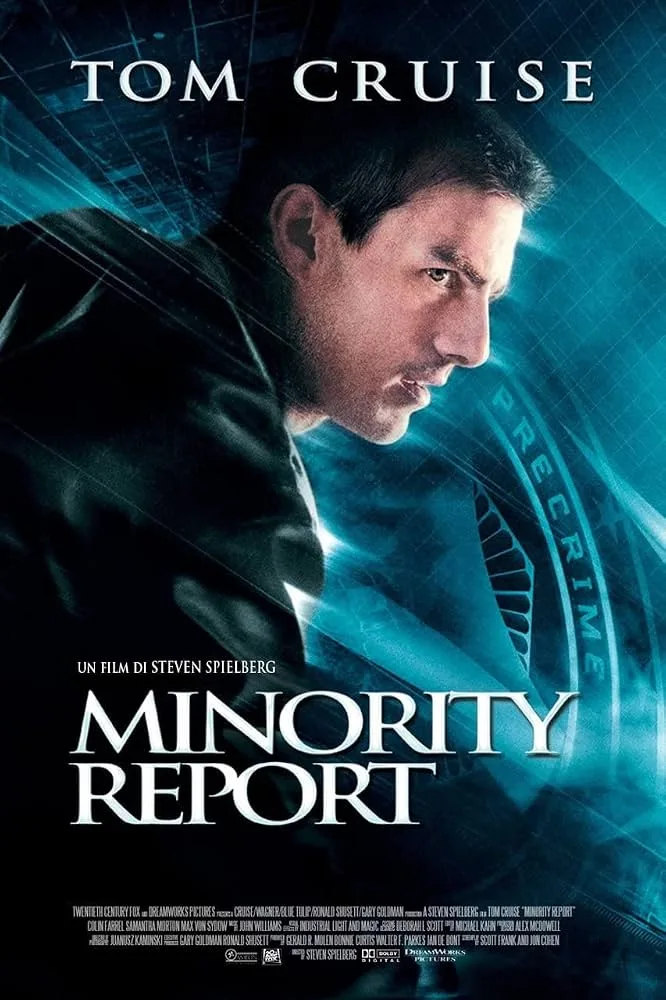
Minority Report
Tense, cerebral, emotionally layered — blending propulsive action with philosophical inquiry and deep personal grief
Based on a publicly circulated draft of this screenplay sourced online — it may differ from the official shooting script or final film. Shown to demonstrate ProofIntelligence.
In a future where three psychics predict murders before they happen, the head of the Precrime unit discovers he has been identified as a future killer and must go on the run to prove his innocence, uncovering a conspiracy that threatens to destroy the very system he built his life around.
Executive Summary
Minority Report is a masterfully constructed sci-fi thriller that represents the gold standard for high-concept genre filmmaking — a script that delivers massive commercial spectacle while engaging with genuinely profound philosophical questions about free will, justice, and the corruption of noble institutions. The screenplay's greatest achievement is its structural elegance: the central paradox (can you punish someone for a crime they haven't committed?) is not merely debated but enacted through every plot turn, culminating in a climax where the antagonist must choose between validating his system by committing murder or destroying it by refusing — a dramatic checkmate that is both intellectually satisfying and emotionally devastating. The script offers a dream leading role for an A-list actor (Anderton's arc from grieving addict to moral hero is one of the great protagonist journeys in modern genre cinema), a gallery of vivid supporting characters (Witwer, Agatha, Iris Hineman, Burgess), and a series of inventive action set-pieces that have become iconic (the hoverpack chase, the spyder sequence, the mall escape). For the Indian market, the themes of surveillance, state power, and institutional corruption are immediately resonant, and the concept could be adapted into a high-budget Hindi or Tamil production with enormous commercial potential. The script's only weaknesses — a slightly overlong factory chase and an exposition-heavy Hineman scene — are minor and easily addressable. This is a ProofScript Elite screenplay: ready for production, proven in the market, and enduring in its craft.
Why this verdict
This is the revised draft of Minority Report, a masterfully constructed sci-fi thriller that marries Philip K. Dick's philosophical provocations with a propulsive detective-story engine. Its core strength is the seamless integration of high-concept world-building with deeply personal stakes — Anderton's grief over his lost son becomes the fulcrum on which the entire plot turns, and the script never lets spectacle overwhelm character. The dialogue is sharp and distinctive, from Witwer's disarming charm to Iris Hineman's acerbic brilliance, and the thematic architecture — free will vs. determinism, the cost of safety, the corruption of noble systems — is woven into every scene without ever becoming didactic. The structure needs no tightening; it is a model of escalation, with the midpoint revelation (Anderton is the predicted killer) detonating the second half into a relentless chase that never loses its moral complexity. The Agatha mall-escape sequence is one of the great set-pieces in modern sci-fi screenwriting. If anything needs polish, it is the slight over-length in the factory chase and a few expository passages in the Hineman scene that could be trimmed for pace. This script sits comfortably in the ProofScript Elite band — a produced, proven piece of screenwriting craft that would command immediate attention from any production house.
What we read
Minority Report is a sci-fi thriller set in a future Washington D.C. where a Precrime division uses three psychic beings to arrest murderers before they kill, and its central dramatic question is whether a man can escape a future that has already been seen — and whether the system that promises perfect justice is itself built on a murder. Chief John Anderton, grieving the kidnapping of his son six years prior, discovers he has been predicted to kill a stranger named Leo Crow, and his desperate flight to prove his innocence peels back layers of conspiracy reaching to Precrime's founder, Lamar Burgess, who killed the Precog Agatha's mother to keep the system — and his power — intact. The script's best element is its structural elegance: the philosophical paradox of predetermination vs. free will is not merely debated in dialogue but enacted through every plot turn, culminating in a climax where Burgess must choose between validating his system by committing murder or destroying it by refusing — a dramatic checkmate that is both intellectually satisfying and emotionally devastating. The Agatha sequences — her guiding Anderton through the mall by seeing seconds into the future — represent some of the most inventive and cinematic writing in the genre.
Score Breakdown
Craft Scores
Weighted craft score
The theme of free will vs. determinism is not merely stated but enacted through every major plot point: the ball-catching scene, Anderton's choice not to kill Crow, Burgess's final paradox. The secondary theme — the corruption of noble systems by those who control them — is woven through Burgess's arc, Iris's bitter regret, and the Precog diorama's lies. The ending (Precrime dismantled, Precogs freed) is the only thematically honest resolution. Band: ProofScript Elite. One band up: A single scene showing the human cost of a wrongful Precrime conviction (someone halo'd who had a Minority Report) would make the theme's stakes even more visceral.
The Howard Marks opening case (pp.2-23) is a self-contained thriller that simultaneously establishes the world, the characters, and the ticking-clock format — one of the most efficient and exciting opening sequences in modern screenwriting. The inciting incident (p.58) detonates the second half into a relentless chase that never loses its moral complexity. The midpoint (Agatha kidnapping, p.117) genuinely shifts the stakes from personal to systemic. The climax (Burgess's paradox, p.184) resolves plot, theme, and character simultaneously. Band: ProofScript Elite. One band up: Tightening the Hineman exposition scene and the factory chase by 3-4 pages total would push the pacing from excellent to flawless.
Anderton's arc — from grieving addict who has sublimated his pain into zealous enforcement, to a man who chooses not to kill despite every reason to — is enacted through scene after scene of escalating moral and physical pressure. The moment he Mirandizes Crow (p.144) instead of killing him is the culmination of everything the story has built. Burgess is a masterfully concealed antagonist whose paternal warmth makes the betrayal devastating. Agatha transforms from plot device to the script's moral center. Band: ProofScript Elite. One band up: Giving Witwer one more scene of independent investigation before his death would complete his arc more satisfyingly.
The screenplay demonstrates exceptional professional craft: scene descriptions are vivid and economical, transitions are purposeful, and the visual storytelling is cinematic throughout. The cross-cutting in the Marks case opening is a masterclass in parallel editing on the page. The script reads like a produced film — every scene is directed in the writing without resorting to camera directions. Minor formatting inconsistencies (occasional missing scene headings, a few character cue variations) are negligible. Band: ProofScript Elite. One band up: Eliminating the few remaining expository passages where characters explain things the audience can see would push the craft to near-perfect.
The pool flashback (p.100) — Anderton underwater while his son vanishes — is devastating in its simplicity. Agatha's monologue about Sean's unlived life (p.160) is the emotional climax of the film, generating genuine tears through specificity ('He runs the two mile and the long relay... he makes love to a pretty girl named Claire'). The Crow confrontation delivers rage, grief, moral triumph, and tragic irony simultaneously. Band: ProofScript Elite. One band up: The Sean hallucination in containment (pp.164-166) slightly dilutes the emotional impact of Agatha's earlier monologue — trimming it would preserve the power of the first scene.
The ball-catching exchange between Anderton and Witwer (p.32) dramatizes the film's philosophical core through a simple physical action — this is dialogue at its most cinematic. Witwer's 'The oracle isn't where the power is anyway. The power's always been with the priests' (p.37) foreshadows the entire conspiracy in a single line. Lara's 'I never said she drowned' (p.170) is one of the great trap-lines in thriller writing. Each character has a distinct voice — Iris's bitter intelligence, Gideon's etymological trivia, Rufus's comic panic. Band: ProofScript Elite. One band up: Reducing the Q&A format in the Hineman scene would eliminate the script's one stretch of functional rather than dramatic dialogue.
Market Scores
Weighted market score
The premise — a cop who prevents murders before they happen is predicted to commit one himself — is one of the great high-concept hooks in cinema. It can be pitched in one sentence and generates inherent, escalating conflict. The concept creates a built-in paradox (if you stop the murder, was it really going to happen?) that drives both the plot and the theme. Band: ProofScript Masterpiece. One band up: This is already at the top — the concept is essentially perfect.
The pool flashback (p.100) — Anderton underwater while his son vanishes — is devastating in its simplicity. Agatha's monologue about Sean's unlived life (p.160) is the emotional climax of the film, generating genuine tears through specificity ('He runs the two mile and the long relay... he makes love to a pretty girl named Claire'). The Crow confrontation delivers rage, grief, moral triumph, and tragic irony simultaneously. Band: ProofScript Elite. One band up: The Sean hallucination in containment (pp.164-166) slightly dilutes the emotional impact of Agatha's earlier monologue — trimming it would preserve the power of the first scene.
The script delivers everything a tentpole requires: a star vehicle lead role, inventive action set-pieces, a high-concept hook, and a world that demands to be seen on the biggest screen possible. The Philip K. Dick brand provides marketing leverage. The themes (surveillance, state power, free will) are more relevant now than when the script was written. The 2002 film's $358M global gross proves the concept's commercial viability. Band: ProofScript Elite. One band up: The tentpole budget requirement is the only factor preventing a higher score — a more contained version of this concept would be even more fundable.
While adapted from Philip K. Dick, the screenplay transforms a short story into a fully realized world with original characters, set-pieces, and thematic architecture. The Precog system, the eye-swap underworld, the spyder technology, and the mall-navigation sequence are all original inventions. The concept of using the system's own logic against itself (the echo murder) is a brilliant structural innovation. Band: ProofScript Elite. One band up: The fugitive-on-the-run structure, while executed brilliantly, follows a well-established template — a more unconventional narrative structure would push originality higher.
Casting
Hrithik Roshan
as ANDERTON
Hrithik combines the physical credibility needed for the action sequences with the emotional depth required for Anderton's grief and moral crisis. His performances in Kaabil and War demonstrate both the vulnerability and the intensity this role demands.
Siddhant Chaturvedi
as WITWER
Siddhant's natural charisma and youthful confidence make him ideal for Witwer's disarming charm that conceals sharp intelligence. His work in Gully Boy showed he can hold the screen against a dominant lead while maintaining his own presence.
Naseeruddin Shah
as BURGESS
Naseeruddin Shah's ability to project avuncular warmth while concealing menace is exactly what Burgess requires. His decades of work in both commercial and art cinema give him the gravitas to make Burgess's betrayal devastating.
Sanya Malhotra
as AGATHA
Sanya's ability to convey profound emotion with minimal dialogue — demonstrated in Photograph and Ludo — makes her ideal for Agatha's largely non-verbal role. Her physicality and expressiveness would bring the Precog's otherworldly quality to life.
Shabana Azmi
as IRIS
Shabana Azmi's commanding screen presence and sharp delivery would make Iris Hineman's bitter intelligence and dangerous eccentricity unforgettable. Her ability to dominate a scene through sheer force of personality mirrors what the role requires.
Deepika Padukone
as LARA
Deepika's ability to convey quiet strength and emotional depth — as seen in Piku and Chhapaak — makes her ideal for Lara's arc from grieving ex-wife to the woman who cracks the case and frees Anderton. She brings both warmth and steel.
Rajkummar Rao
as FLETCHER
Rajkummar's everyman quality and ability to convey conflicted loyalty make him perfect for Fletcher, the second-in-command torn between duty and friendship. His range from Stree to Newton shows he can handle both the action and emotional demands.
Pacing & Rhythm
Overall pace
Fast with strategic decelerations
The pacing follows a sophisticated wave pattern rather than a simple escalation. The opening Marks case (pp.2-23) establishes a complete thriller rhythm in miniature, then the script deliberately decelerates for character development (pp.23-55) before the inciting incident launches the sustained second-act chase. The Hineman scene (pp.76-85) provides a necessary breather between action sequences but is the script's one pacing vulnerability — it runs slightly long. The third act maintains excellent pace through the intercutting phone-call sequence. The epilogue is appropriately brief.
SLOW · pp. 76–85
The Iris Hineman estate scene — extended exposition about Precog origins and Minority Reports delivered through dialogue
Fix: Trim by 2-3 pages by seeding some backstory earlier and letting Iris's character energy carry less information per exchange
SLOW · pp. 51–55
The TV debate and solarium scenes — Anderton's public and private faces shown in sequence
Fix: The TV debate could be compressed to its key exchange (the Miranda rights question) without losing its function
RUSHED · pp. 155–156
Witwer's murder by Burgess — the script's most competent secondary character is dispatched in barely a page
Fix: Add 2-3 beats of Witwer sensing danger or attempting to defend himself to honor the character's established intelligence
Conflict Escalation
The conflict escalation follows a masterful double-peak structure. The first peak (p.21, Howard Marks arrest) establishes the system's power and the ticking-clock format. After a deliberate valley for character development and world-building (pp.23-50), the second escalation begins with the inciting incident (p.58) and builds relentlessly through the chase sequences, spyder scene, and temple kidnapping. The Crow confrontation (p.147) is the emotional and dramatic peak — the moment where every thread converges. The Burgess revelation and terrace climax (p.184) provide a second peak of equal intensity but different register (intellectual rather than visceral). The script's genius is in maintaining tension even during its quieter passages through dramatic irony and ticking clocks.
Peak moment · page 147
Crow forces Anderton to pull the trigger by grabbing the gun muzzle and yanking — the Precog vision comes true despite Anderton's choice not to kill, creating the most devastating moment of the script where free will and predetermination collide
Protagonist Arc
Anderton's arc follows a classic descent-and-resurrection pattern, but with unusual complexity. His starting state is not high — he is already broken by grief and addiction, maintaining a functional facade through work. The inciting incident (p.58) strips away even that facade. His lowest point is not the arrest (p.162) but the discovery of Sean's photograph (p.140), because it weaponizes his deepest wound. His moral triumph — choosing not to kill Crow (p.147) — is the true turning point, occurring before his physical lowest point (containment). This inversion is structurally brilliant: Anderton wins his soul before he loses his freedom, making the external rescue (Lara freeing him) feel earned rather than convenient.
Scene Audit
150 scenes evaluated — tension, pacing contribution, and whether each earns its place.
| Pg | Scene | Purpose | Tension | Verdict |
|---|---|---|---|---|
| 2 | BLACK AGATHA | Opens with fragmented Precog vision establishing the visual language and central murder predictionBrilliant cold open — hooks immediately | 70accelerates | essential |
| 3 | A SERIES OF IMAGES AGATHA | Continues the Precog vision, revealing the three Precog faces and the murder they're witnessingEstablishes Precog mechanics visually | 75accelerates | essential |
| 3 | A RED BALL - ANALYTICAL ROOM | Introduces the Red Ball system and victim/killer identificationEfficient world-building through action | 65accelerates | essential |
| 4 | INSIDE PRECRIME HEADQUARTERS - MAIN FLOOR ANDERTON | Introduces Anderton entering the buildingFirst look at protagonist in his element | 50maintains | essential |
| 4 | INT. PRECRIME ANALYTICAL ROOM - MORNING ANDERTON · JAD | Anderton begins working the case with Jad, establishing the team dynamic and proceduresSets up the procedural engine | 60accelerates | essential |
| 4 | INT. POLLARD'S OFFICE - MORNING | Witness validation of the Precog predictionEstablishes legal framework quickly | 40maintains | essential |
| 5 | INT. DR. JAMES' OFFICE - MORNING | Second witness validationBrief, functional | 40maintains | essential |
| 5 | INT. PRECRIME ANALYTICAL ROOM - MORNING ANDERTON | Anderton 'scrubs' the Prevision images, searching for location cluesShowcases the scrubbing interface — key visual concept | 65accelerates | essential |
| 5 | INT. SUBURBAN D.C. KITCHEN - MORNING SARAH · HOWARD | Introduces the Marks family in their domestic routine — the future murder victimsHumanizes the victims, builds dramatic irony | 55decelerates | essential |
| 6 | INT. PRECRIME ANALYTICAL ROOM - MORNING ANDERTON · JAD | Team searches for Howard Marks' identity and locationTicking clock intensifies | 70accelerates | essential |
| 6 | EXT. BROWNSTONE IN GEORGETOWN - MORNING HOWARD · SARAH | Howard leaves the house, sees the muscular man across the streetCross-cutting builds tension masterfully | 65maintains | essential |
| 7 | INT. PRECRIME ANALYTICAL ROOM - MORNING ANDERTON · JAD | Anderton analyzes the wet newspaper, searches for architectural cluesDetective work drives the procedural | 70accelerates | essential |
| 7 | EXT. BROWNSTONE - MORNING HOWARD · SARAH | Howard notices the man across the street, Sarah appearsDramatic irony — we know what Howard doesn't | 60maintains | essential |
| 8 | INT. PRECRIME ANALYTICAL ROOM - MORNING ANDERTON · JAD · FLETCHER | Jad identifies Howard Marks' address, team prepares to deployClock ticking — 17 minutes | 75accelerates | essential |
| 9 | INT. PRECRIME READY ROOM - MORNING KNOTT | Team gears up — introduces sick-sticks and team dynamicsEfficient character/world-building in action | 60maintains | essential |
| 9 | INT. PRECRIME ANALYTICAL ROOM - MORNING ANDERTON · JAD · FLETCHER · WITWER | Location problem — the house has burned down; introduces WitwerComplication raises stakes, Witwer entrance is perfectly timed | 75accelerates | essential |
| 13 | INT. MARKS KITCHEN - MORNING HOWARD · SARAH | Howard decides to stay home — the domestic scene that will lead to murderQuiet dread — we know what's coming | 65decelerates | essential |
| 15 | INT. PRECRIME ANALYTICAL ROOM - MORNING ANDERTON · JAD · BURGESS | Anderton gears up while working, Burgess calls with political pressureEstablishes Burgess-Anderton dynamic | 70accelerates | essential |
| 16 | INT. MARKS KITCHEN - MORNING HOWARD · SARAH | Howard leaves, Sarah watches — the affair is about to happenBrief, effective transition | 60maintains | essential |
| 16 | INT. PRECRIME ANALYTICAL ROOM - MORNING ANDERTON · JAD | Anderton deduces the merry-go-round location from the PrevisionBrilliant detective work — kid on merry-go-round | 75accelerates | essential |
| 16 | EXT. PARK ACROSS FROM THE MARKS BROWNSTONE - MORNING HOWARD · SARAH | The lover enters the house; Howard sees and staysThe murder chain begins | 80accelerates | essential |
| 16 | INT. PRECRIME - MORNING ANDERTON · FLETCHER · WITWER | Team deploys, Witwer asks to tag alongWitwer's persistence established | 70accelerates | essential |
| 17 | EXT. DEPARTMENT OF PRECRIME - ROOF - MORNING ANDERTON · EVANNA | Team boards hovership, conspicuously empty seat (no room for Witwer)Visual detail — the empty seat | 70accelerates | essential |
| 18 | EXT. MARKS HOUSE - GEORGETOWN - MORNING HOWARD | Howard enters the house with the scissorsPoint of no return for Howard | 85accelerates | essential |
| 18 | INT. MARKS HOUSE - KITCHEN - MORNING HOWARD | Howard picks up scissors, hears laughing upstairsTension at peak — cross-cutting begins | 85accelerates | essential |
| 18 | INT. HOVERSHIP - MORNING ANDERTON | Anderton checks countdown — 5:38Ticking clock visual | 85accelerates | essential |
| 18 | INT. MARKS HOUSE - MORNING HOWARD | Howard watches the lover pass, starts up stairsUnbearable suspense | 90accelerates | essential |
| 18 | EXT. D.C. - MORNING | Hovership races over WashingtonBrief establishing shot — maintains pace | 80maintains | essential |
| 18 | INT. MARKS HOUSE - MORNING HOWARD | Howard pushes open bedroom door with scissorsMaximum tension | 92accelerates | essential |
| 18 | INT. BEDROOM - MORNING HOWARD · SARAH | Sarah and lover in bathroom; Howard reflected in mirrorMirror motif introduced | 93accelerates | essential |
| 18 | EXT. PARK - MORNING ANDERTON | Precops drop in, kid on merry-go-round watchesArrival — will they make it? | 90accelerates | essential |
| 19 | INT. BEDROOM - MORNING HOWARD | Howard weeps on the floor, scissors in handHumanizes the would-be killer | 88maintains | essential |
| 19 | EXT. PARK - MORNING ANDERTON | Anderton realizes all houses look alike — which one?Final complication — brilliant | 92accelerates | essential |
| 19 | INT. PRECRIME HOVERSHIP - MORNING EVANNA | Evanna watches the vision repeat — one minute leftClock at critical point | 93accelerates | essential |
| 19 | INT. PRECRIME ANALYTICAL ROOM - MORNING ANDERTON · JAD · WITWER | Anderton asks if the front door was open — the key deductionBrilliant detective logic under pressure | 95accelerates | essential |
| 20 | EXT. PARK - MORNING ANDERTON | Anderton spots the open door, sprints for the houseThe race to prevent murder | 95accelerates | essential |
| 20 | INT. BEDROOM - MORNING HOWARD · SARAH | Lovers on bed, Howard rocked by their motion, raises scissorsUnbearable — scissors rising | 98accelerates | essential |
| 21 | INT. HOUSE - MORNING ANDERTON | Anderton sprints up stairs, watch counting downFinal seconds | 98accelerates | essential |
| 21 | INT. BEDROOM - MORNING ANDERTON · HOWARD · SARAH · KNOTT · FLETCHER | Anderton grabs Howard's hand at the last second — arrestPayoff of entire opening sequence — masterful | 95accelerates | essential |
| 23 | INT. PRECRIME ANALYTICAL ROOM - MORNING WITWER · JAD | Witwer sees the 'echo' — Precog Deja Vu explainedPlants crucial concept for the climax | 40decelerates | essential |
| 23 | INT. MARKS HOUSE - MORNING ANDERTON · SARAH | Anderton shuts off the bathtub water, sees Sarah confusedQuiet aftermath — emotional beat | 30decelerates | essential |
| 23 | EXT. INNER CITY - NIGHT ANDERTON | Anderton jogs through the city, Precrime propaganda projected on wallsWorld-building and character — Anderton's double life | 35decelerates | essential |
| 23 | INT. A DARK ROOM - NIGHT HOWARD | Howard Marks being processed — halo fittedShows the consequence of arrest — chilling | 50maintains | essential |
| 25 | EXT. INNER CITY - DARK ANDERTON · LYCON | Anderton buys drugs from Lycon — reveals addiction and Lycon's missing eyesEstablishes Anderton's flaw and the eye-swap underworld | 40decelerates | essential |
| 26 | INT. ANDERTON'S APARTMENT - NIGHT ANDERTON · SEAN | Anderton's messy apartment, kid's room, holographic images of SeanDevastating character scene — the emotional core | 30decelerates | essential |
| 29 | INT. ANDERTON'S APARTMENT - MORNING ANDERTON · BURGESS | Anderton wakes to Nash press conference, realizes he's lateTransitions to political stakes | 45accelerates | essential |
| 30 | EXT. PRECRIME - DAY ANDERTON · BURGESS | Anderton arrives, confronted by Burgess about his behaviorBurgess as mentor/authority figure established | 55maintains | essential |
| 31 | INT. PRECRIME ANALYTICAL ROOM - DAY WITWER · FLETCHER · JAD · KNOTT · ANDERTON | Team shows Witwer the wooden eggs; philosophical debate about Precrime's legalityThematic debate dramatized through character conflict | 50maintains | essential |
| 35 | INSIDE THE TEMPLE ANDERTON · WITWER · WALLY · AGATHA | Witwer and Anderton visit the Precogs; Witwer's theological perspective; Agatha grabs AndertonCritical scene — Agatha's first contact, Anne Lively vision | 70accelerates | essential |
| 41 | EXT. THE DEPARTMENT OF CONTAINMENT - EARLY MORNING ANDERTON · GIDEON | Anderton visits Containment to investigate Anne Lively's murderIntroduces Containment and Gideon | 45maintains | essential |
| 45 | INT. ANDERTON'S APARTMENT - DAY WITWER · SEAN | Witwer searches Anderton's apartment, discovers the holograms and inhalersWitwer finds Anderton's vulnerability | 50maintains | essential |
| 46 | INT. DEPARTMENT OF CONTAINMENT - DAY ANDERTON · GIDEON | Anderton and Gideon find Anne Lively's file — Agatha's data stream is missingKey discovery — missing prevision | 60accelerates | essential |
| 48 | INT. BURGESS' LIVING ROOM - DAY ANDERTON · BURGESS | Anderton tells Burgess about the missing previsions; Burgess deflects and warns about Anderton's drug useBurgess manipulates — plants seeds of doubt | 55maintains | essential |
| 51 | INT. TELEVISION SOUND STAGE - MORNING ANDERTON · BURGESS | Anderton debates Precrime on TV — public face of the systemSlightly long — could be trimmed without losing function | 40decelerates | needs_work |
| 53 | INT. SOLARIUM - NIGHT ANDERTON · LARA · SEAN | Anderton watches his TV appearance, then holographic images of Lara and Sean; discovers the cracked ceilingDeepens the emotional portrait — addiction and grief | 35decelerates | essential |
| 55 | INT. PRECRIME HEADQUATERS - ANDERTON'S OFFICE - DAY ANDERTON · WITWER | Anderton pockets the Anne Lively data card, sees Witwer charming the staffWitwer as threat — social infiltration | 45maintains | essential |
| 55 | INT. PRECRIME ANALYTICAL ROOM - DAY ANDERTON · JAD | The Leo Crow prevision begins — Anderton discovers he is the predicted killerTHE inciting incident — masterfully executed | 95accelerates | essential |
| 59 | INT. TEMPLE - DAY WALLY · ANDERTON | Wally sees the prevision, gives Anderton two minutes to runWally's loyalty — touching and tense | 85accelerates | essential |
| 60 | INT. PRECRIME HEADQUATERS - MAIN FLOOR - DAY ANDERTON · FLETCHER | Anderton walks through the office in a daze, gets on the elevatorSurreal quality — life changing in real time | 80accelerates | essential |
| 61 | INT. ELEVATOR - DAY ANDERTON · WITWER | Anderton confronts Witwer at gunpoint; the siren goes offBrilliant reversal — Witwer thinks he has leverage, then the siren | 90accelerates | essential |
| 62 | EXT. D.C. STREETS - DAY ANDERTON · BURGESS | Anderton flees in his car, calls BurgessThe fugitive run begins | 85accelerates | essential |
| 64 | EXT. VEHICLE - DAY ANDERTON | Anderton kicks through windshield, leaps to balcony, crashes through exercise studioSpectacular escape — Break into Two | 90accelerates | essential |
| 65 | INT. BURGESS' OFFICE - DAY BURGESS · FLETCHER · WITWER | Burgess, Fletcher, and Witwer — Witwer takes control of the teamPower shift — Witwer ascendant | 65maintains | essential |
| 66 | EXT. MALL - DAY ANDERTON | Anderton moves through the city, personalized ads call his nameWorld-building as obstacle — surveillance state | 60maintains | essential |
| 67 | INT. BRIEFING ROOM - DAY WITWER · FLETCHER · EVANNA · KNOTT | Witwer addresses the team, replaces some members with federal agentsWitwer's competence and ruthlessness | 60maintains | essential |
| 68 | INT. MALL - DAY ANDERTON | Anderton avoids EYE scanners, boards the MetroTension of surveillance — every scan a threat | 70accelerates | essential |
| 68 | INT. PRECRIME ANALYTICAL ROOM - DAY JAD · WITWER · FLETCHER | Jad tracks Anderton on the MetroThe hunt intensifies | 75accelerates | essential |
| 69 | INT. SUBWAY - METRO STATION - DAY ANDERTON · FLETCHER | Anderton exits to find nine Precrime cops waiting — chase beginsSpectacular action sequence launch | 85accelerates | essential |
| 69 | EXT. SUBWAY STATION - DUPONT CIRCLE - DAY ANDERTON · FLETCHER · KNOTT | Anderton runs, hoverpack chase through alleys and buildingsExtended action — inventive and thrilling | 90accelerates | essential |
| 71 | INT. TENEMENT - DAY ANDERTON · KNOTT | Anderton and Knott crash through apartments on the hoverpackDomestic chaos — great visual comedy amid action | 85accelerates | essential |
| 72 | EXT. BUILDING - DAY ANDERTON | Anderton hides in dumpster as cops fly awayBrief respite — clever escape | 60decelerates | essential |
| 72 | EXT. LEXUS FACTORY - DAY ANDERTON | Anderton breaks into the factoryTransition to factory sequence | 65maintains | essential |
| 72 | INT. LEXUS FACTORY - ENTRY AREA - DAY ANDERTON · WITWER | Precops enter the factory in pursuitSets up the factory chase | 70accelerates | essential |
| 73 | INT. MAIN FACTORY AREA - DAY ANDERTON · WITWER | Extended fight through the automated assembly line — Price, Paymen, WitwerInventive but overlong — could lose one agent encounter | 85accelerates | needs_work |
| 75 | INT./ EXT. RED LEXUS - MARYLAND COUNTRYSIDE - DAY ANDERTON | Anderton drives away in the newly assembled carGreat payoff — drives out in the car built around him | 50decelerates | essential |
| 76 | EXT. A WALLED ESTATE - DAY ANDERTON | Anderton arrives at Iris Hineman's estate, climbs the wallAtmospheric transition — rural isolation | 45decelerates | essential |
| 76 | EXT. THE GARDENS - DAY ANDERTON · IRIS | Anderton is attacked by predatory plants, poisoned by Doll's Eye vineIris's world established — dangerous and eccentric | 55maintains | essential |
| 78 | INT. GREENHOUSE (implied) ANDERTON · IRIS | Iris explains the origins of Precrime, the Precogs, and the existence of Minority ReportsCritical exposition — slightly long but Iris is compelling | 50decelerates | essential |
| 86 | INT. ANDERTON'S OFFICE - PRECRIME FLETCHER · WITWER · JAD · KNOTT | Fletcher works the Prevision; Witwer investigates Anderton's office, finds the holo-computerParallel investigation — Witwer closing in | 55maintains | essential |
| 88 | EXT. INNER CITY SLUMS - DAY ANDERTON | Anderton arrives at Dr. Eddie's for the eye replacement surgeryDescent into the underworld | 50maintains | essential |
| 88 | INT. DR. EDDIE'S "OPERATING" ROOM - DAY ANDERTON · DR. EDDIE | Dr. Eddie — a criminal Anderton once arrested — performs the eye swapDark comedy and irony — brilliant character | 60maintains | essential |
| 93 | EXT. BEACH COTTAGE - CHESAPEAKE BAY - DAY WITWER · LARA | Witwer visits Lara, questions her about Anderton's drug use and Sean's disappearanceB-story deepens — Lara's perspective on the marriage | 45decelerates | essential |
| 97 | INT. TENEMENT ROOM - DAY ANDERTON · DR. EDDIE · LYCON | Anderton recovers from surgery, bandaged, given instructions and the paralytic enzymeSetup for the spyder sequence and face-change | 45maintains | essential |
| 99 | EXT. TENEMENT CITY - DAY ANDERTON | Precrime ship cruises past; Anderton takes the inhaler, flashes back to the poolTransition to the Sean flashback | 40decelerates | essential |
| 100 | A PUBLIC POOL - DAY ANDERTON · SEAN | Flashback — Anderton and Sean at the pool; Sean disappears while Anderton is underwaterThe defining trauma — devastating and economical | 75accelerates | essential |
| 101 | INT. TENEMENT ROOM - NIGHT ANDERTON | Anderton crushes the inhaler, follows the rope to the kitchenCharacter moment — rejecting the drug after the memory | 40maintains | essential |
| 101 | INT. PRECRIME HOVERSHIP - NIGHT EVANNA | Evanna positions for thermal scan of the tenementThe spyder sequence begins | 55accelerates | essential |
| 101 | INT. TENEMENT ROOM - NIGHT ANDERTON | Anderton fumbles in the fridge, eats rotten food, hears arguing next doorDark comedy — blind man in a filthy kitchen | 50maintains | essential |
| 102 | EXT. TENEMENT - NIGHT FLETCHER · KNOTT | Fletcher and Knott deploy spyders into the buildingSpyders introduced — brilliant concept | 65accelerates | essential |
| 103 | INT. A ROOM - NIGHT | Old woman scanned by spyder — shows the processEstablishes spyder mechanics with character | 55maintains | essential |
| 104 | INT. ANDERTON'S ROOM - NIGHT ANDERTON | Anderton hears the couple next door, then the spyders approachingTension builds — spyders closing in | 75accelerates | essential |
| 105 | INT. BATHROOM - NIGHT ANDERTON | Anderton fills the tub with ice water, submerges to hide his thermal signatureIngenious escape attempt — will it work? | 85accelerates | essential |
| 107 | INT. BATHROOM - NIGHT ANDERTON | Spyders stack on each other to reach the tub; Anderton must expose his healing eye to the scanExcruciating tension — the eye nearly destroyed | 95accelerates | essential |
| 109 | INT. TENEMENT - HALLWAY - DAY FLETCHER · KNOTT | Fletcher and Knott arrive at Anderton's door just as the spyders clear himNarrow escape — perfectly timed | 85accelerates | essential |
| 109 | INT. PUBLIC TRANSPORTATION SYSTEM (implied) ANDERTON | Anderton with new eyes rides the subway, passes the scannerNew identity works — but his eyes look wrong | 55maintains | essential |
| 110 | INT. ANDERTON'S OFFICE - DAY WITWER · FLETCHER | Witwer discovers Agatha's face in the mirror of the PrevisionKey deduction — Anderton is coming for Agatha | 65accelerates | essential |
| 110 | EXT. PLAZA NEAR GOVERNMENT BUILDING - DAY ANDERTON | Anderton joins a tour group, injects the paralytic enzyme to disguise his faceClever infiltration — the Precog diorama is a great detail | 70accelerates | essential |
| 112 | INT. PRECRIME TEMPLE - DAY ANDERTON · WALLY | Wally flushes the tank; Anderton enters through the nutrient roomThe heist begins | 80accelerates | essential |
| 113 | INT. NUTRIENT ROOM - DAY ANDERTON | Anderton uses his old eyes to pass the EYEscanPayoff of the eye-swap — tense and darkly comic | 75accelerates | essential |
| 113 | INT. ANDERTON'S OFFICE - DAY WITWER · FLETCHER | Witwer enhances the mirror image — confirms it's AgathaParallel deduction — race against time | 70accelerates | essential |
| 114 | INT. PRECOG TEMPLE - DAY ANDERTON · WALLY · AGATHA | Anderton confronts Wally, jams the door, begins downloading from AgathaThe kidnapping — Agatha shows Anne Lively images | 85accelerates | essential |
| 117 | INT. PRECOG TEMPLE - DAY ANDERTON · AGATHA · WITWER · WALLY | Anderton throws the lever, drains the tank, escapes with Agatha through the drainMIDPOINT — system disabled, Agatha taken | 90accelerates | essential |
| 119 | EXT. ALLEY - DAY ANDERTON · AGATHA | Anderton carries Agatha to the LexusBrief transition — maintains momentum | 70maintains | essential |
| 119 | INT. PRECRIME ANALYTICAL ROOM - DAY WITWER · FLETCHER | Witwer realizes Agatha is already part of Anderton's future — they can't stop the murder without finding the roomStakes clarified — the paradox deepens | 65maintains | essential |
| 120 | INT. LEXUS - MOVING - DAY ANDERTON · AGATHA | Anderton and Agatha drive through the inner city; she experiences the world for the first timeBeautiful character moment — Agatha's wonder | 40decelerates | essential |
| 121 | INT. MALL CITY - DAY ANDERTON · AGATHA | Anderton goes to the Gap; Agatha saves Nathan from the falling beamAgatha's gift used for good — she saves a life | 55maintains | essential |
| 124 | INT. ANDERTON'S OFFICE - DAY WITWER · JAD · FLETCHER · SEAN | Witwer studies the Prevision, sees Sean's hologram, realizes Anderton is trying to prove innocenceWitwer's empathy — he understands Anderton | 50maintains | essential |
| 125 | INT. RUFUS' DREAMWEAVER HEADSPA - DAY ANDERTON · AGATHA · RUFUS | Anderton brings Agatha to Rufus for downloading; Rufus' comic reactionComic relief that serves the plot | 50maintains | essential |
| 129 | INT. RUFUS RILEY'S BASEMENT - DAY ANDERTON · AGATHA · RUFUS | Agatha's memories downloaded — the Anderton/Crow murder plays out, then Anne Lively images; no Minority Report exists for AndertonDevastating revelation — no alternate future | 75accelerates | essential |
| 131 | INT. NEUROPLEX - DAY WITWER · RUFUS · ANDERTON · AGATHA | Witwer and team search the cyberparlor; Rufus leads Anderton and Agatha out the backNear-miss — tension maintained | 70accelerates | essential |
| 132 | EXT. OUTDOOR CLOTHING MARKET - DAY ANDERTON · AGATHA | Agatha begins guiding Anderton through the mall using her precognitive abilityThe mall sequence begins — one of the script's best | 75accelerates | essential |
| 132 | INT. INNER CITY - MALL - DAY ANDERTON · AGATHA · KNOTT | Agatha predicts the man dropping his briefcase, the woman in brown, the balloon vendor, Knott's movements — guiding Anderton through a gauntlet of near-missesMasterpiece sequence — precognition as real-time navigation | 85accelerates | essential |
| 135 | EXT. STREET - DAY ANDERTON · AGATHA · KNOTT | Rain starts, umbrellas hide them; Agatha has Anderton tie a kid's shoe to avoid Knott; Anderton spots the Revo billboardThe 6/9 and sunglasses clues converge — brilliant | 80accelerates | essential |
| 136 | INT. RUFUS' CYBER PARLOR - DAY WITWER · RUFUS | Witwer sees the Anne Lively murder — confused by what Agatha wanted Anderton to seeWitwer's investigation parallels Anderton's | 55maintains | essential |
| 137 | INT. HOTEL - DAY ANDERTON · AGATHA | Anderton finds Crow's name in the register; Agatha begs him to walk awayThe choice — Agatha offers an exit he refuses | 80accelerates | essential |
| 139 | INT. ROOM - DAY ANDERTON · AGATHA | Wrong room — the 6 pivots to 9; Anderton finds the real 1006Payoff of the 6/9 visual clue — satisfying | 75accelerates | essential |
| 140 | INT. THE REAL 1006 - DAY ANDERTON · AGATHA | Anderton finds photographs of kidnapped children including Sean — emotional devastationGut-punch — the personal stakes explode | 90accelerates | essential |
| 141 | INT. LOBBY - DAY CROW | Crow enters the hotelBrief — builds dread | 80accelerates | essential |
| 141 | INT. HOTEL ROOM - DAY ANDERTON · AGATHA · CROW | Anderton tells Agatha he's going to kill Crow; the confrontation with Crow — confession, Miranda rights, Crow forces the gunThe script's dramatic peak — choice, tragedy, and twist | 98accelerates | essential |
| 147 | INT. HALLWAY - DAY ANDERTON · AGATHA | Agatha leads stunned Anderton away; woman screams 'Murder!'Aftermath — the word 'murder' echoes | 75maintains | essential |
| 148 | INT. PRECRIME HOVERSHIP - DAY WITWER | Witwer arrives at the hotel, sees the bodyInvestigation shifts to Witwer | 60maintains | essential |
| 148 | INT. CROW'S HOTEL ROOM - DAY WITWER · FLETCHER | Witwer examines the scene — 'orgy of evidence' — realizes it was arrangedWitwer's detective instincts — crucial deduction | 55maintains | essential |
| 149 | INT. DARK ROOM (Lara's) - DAY ANDERTON · LARA | Anderton calls Lara, tells her Crow is dead but he didn't kill himEmotional reconnection — Lara as lifeline | 45decelerates | essential |
| 150 | INT. LEXUS - DAY ANDERTON · AGATHA | Agatha and Anderton drive along the coast; Agatha says she must go backAgatha's selflessness — she sees herself returning | 35decelerates | essential |
| 151 | INT. BURGESS' HOUSE - DAY BURGESS · WITWER | Burgess watches CNN coverage; Witwer calls about the Anne Lively discoverySets up Witwer's murder — Burgess cornered | 60accelerates | essential |
| 152 | INT. ANDERTON'S APARTMENT - DAY WITWER · BURGESS | Witwer shows Burgess the two Anne Lively murders — different wind directions prove two separate events; Burgess shoots WitwerThe twist — Burgess revealed as the killer; Witwer's death is shocking | 95accelerates | essential |
| 156 | INT. THE COTTAGE - DAY LARA · BURGESS | Lara calls Burgess for help; Burgess manipulates her into keeping Anderton thereDramatic irony — Lara trusts the villain | 65maintains | essential |
| 157 | EXT. THE CLIFF COTTAGE - DAY ANDERTON · LARA · AGATHA | Anderton arrives with Agatha; Lara greets themBrief reunion — calm before the storm | 40decelerates | essential |
| 158 | EXT. COTTAGE - DUSK ANDERTON · LARA | Anderton and Lara talk; she sees his new eyesIntimate moment — the cost of his journey visible | 35decelerates | essential |
| 158 | INT. COTTAGE - DUSK AGATHA | Agatha explores the house, finds Sean's room, takes the Anne Lively cardSetup for the revelation about Anne Lively | 40maintains | essential |
| 159 | EXT. COTTAGE - NIGHT ANDERTON · LARA | Anderton realizes the setup was because he found out about Anne LivelyThe pieces click into place | 60accelerates | essential |
| 159 | INT. CLIFF HOUSE - NIGHT ANDERTON · AGATHA · LARA | Anderton finds Agatha in Sean's room; she describes Sean's unlived life; reveals Anne Lively was her motherThe emotional climax — devastating and beautiful | 70maintains | essential |
| 162 | INT. HOUSE - NIGHT (SLOW MOTION) ANDERTON · KNOTT · AGATHA · LARA · FLETCHER | Precrime arrests Anderton; he learns Witwer is dead; Agatha whispers to cops; halo fittedThe fall — Anderton loses everything | 85accelerates | essential |
| 163 | INT. PRECOG TANK (implied) WALLY · AGATHA | Wally returns Agatha to the tank, reconnects herWally's possessiveness — unsettling | 45decelerates | essential |
| 163 | INT. A DARK PLACE ANDERTON · GIDEON | Anderton is placed in containment; Gideon welcomes himThe hero imprisoned — lowest point | 50maintains | essential |
| 164 | INT. DEPARTMENT OF CONTAINMENT - DAY ANDERTON · SEAN | Anderton sinks into the containment tier; hallucinates SeanDream sequence — emotional and thematic | 45decelerates | essential |
| 166 | INT. LAMAR BURGESS' OFFICE - DAY LARA · BURGESS | Lara visits Burgess; he gives her Anderton's belongings; she probes about Anne Lively and catches him in the lie'I never said she drowned' — the trap springs | 80accelerates | essential |
| 170 | INT. DEPARTMENT OF CONTAINMENT - NIGHT LARA · GIDEON | Lara frees Anderton using his old eyesThe rescue — payoff of the eye-swap | 70accelerates | essential |
| 171 | EXT. WILLARD HOTEL - NIGHT | News coverage of the Precrime Amendment ratificationContext for the climax — national stakes | 50maintains | essential |
| 171 | INT. HOTEL BALLROOM - NIGHT BURGESS | Burgess' victory gala; Nash announces Burgess will lead national PrecrimeThe villain at his peak — about to fall | 55maintains | essential |
| 171 | INT. PRECRIME ANALYTICAL ROOM - NIGHT FLETCHER · KNOTT · EVANNA | The team watches glumly; Fletcher drunkThe team's moral crisis — effective | 40maintains | essential |
| 172 | INT. WILLARD BALLROOM - NIGHT BURGESS · LARA | Burgess receives the antique revolver; gives his speech; Anderton callsThe gun — Chekhov's revolver loaded with gold bullets | 65accelerates | essential |
| 174 | INT. PRECRIME ANALYTICAL ROOM - NIGHT JAD · LARA | Jad patches in the Anderton-Burgess call; Lara coordinatesThe broadcast begins — team becomes ally | 70accelerates | essential |
| 175 | INT. HOTEL BALLROOM - NIGHT ANDERTON · BURGESS · AGATHA | Anderton narrates the Anne Lively murder over the phone while Agatha's memories play on the ballroom screen; Burgess tries to escape the crowdTour de force intercutting — the conspiracy exposed publicly | 90accelerates | essential |
| 180 | INT. HOTEL KITCHEN - NIGHT ANDERTON · BURGESS | Burgess stalks Anderton through the kitchen; philosophical debate about the system's valueCat and mouse — ideas and action fused | 85accelerates | essential |
| 182 | INT. PRECRIME ANALYTICAL ROOM - NIGHT FLETCHER · JAD | The team sees the Red Ball — Burgess predicted to kill AndertonThe system predicts its creator's crime — perfect irony | 90accelerates | essential |
| 184 | EXT. HOTEL TERRACE - NIGHT ANDERTON · BURGESS · EVANNA | Anderton confronts Burgess with the paradox; Burgess shoots himselfThe climax — intellectually and emotionally perfect | 98accelerates | essential |
| 186 | EXT. PRECRIME HEADQUATERS - DAY | Epilogue — Precrime dismantled, statue removedVisual closure — the system undone | 20decelerates | essential |
| 187 | INT. ANDERTON'S APARTMENT - DAY ANDERTON · LARA | Anderton and pregnant Lara watch the rain togetherEmotional closure — new life, real presence | 15decelerates | essential |
| 187 | EXT. SMALL ISLAND (implied) AGATHA | The three Precogs live freely on a remote islandFinal image — freedom, peace, isolation | 10decelerates | essential |
Beat Sheet · Save The Cat
| Beat | Scene | Timing | Present | Quality |
|---|---|---|---|---|
Opening Image The fragmented Precog vision of Howard Marks' future murder — scissors, faces, water — establishes the visual language and central concept | BLACK | On target | 95 | |
Theme Stated Witwer's debate with Anderton about predetermination — 'But it's not the future if you stop it. Isn't that a fundamental paradox?' — states the film's central thematic question | INT. PRECRIME ANALYTICAL ROOM - MORNING | Arrives late | 90 | |
Set-Up The Howard Marks case demonstrates the Precrime system, introduces Anderton and his team, establishes the political stakes (national referendum), and reveals Anderton's personal demons (drug use, lost son) | INSIDE PRECRIME HEADQUARTERS - MAIN FLOOR | On target | 95 | |
Catalyst Anderton sees his own face on the Prevision screen as the predicted killer of Leo Crow — the inciting incident that transforms him from hunter to hunted | INT. PRECRIME ANALYTICAL ROOM - DAY | Arrives late | 98 | |
Debate Anderton confronts Witwer in the elevator, calls Burgess from his car, and debates whether to run or turn himself in — compressed but effective | INT. ELEVATOR - DAY | Arrives late | 85 | |
Break into Two Anderton kicks through his car windshield and leaps to a balcony — a literal and figurative break from his old life, committing fully to the fugitive path | EXT. VEHICLE - DAY | Arrives late | 90 | |
B Story Witwer visits Lara at the cottage — the B story of Anderton's marriage and grief, which will become the mechanism of his salvation in Act Three | EXT. BEACH COTTAGE - CHESAPEAKE BAY - DAY | Arrives late | 85 | |
Fun and Games The hoverpack chase through Georgetown, the Lexus factory fight, the eye-replacement surgery, and the spyder sequence — the 'promise of the premise' delivered through inventive action set-pieces | INT. SUBWAY - METRO STATION - DAY | On target | 92 | |
Midpoint Anderton kidnaps Agatha from the temple, disabling the entire Precrime system — stakes shift from personal to systemic, and Agatha becomes an active character | INT. PRECOG TEMPLE - DAY | Arrives late | 95 | |
Bad Guys Close In Witwer and the team close in at Rufus' cyberparlor; Anderton discovers there is no Minority Report for him; the Anne Lively images intensify | INT. RUFUS' CYBER PARLOR - DAY | Arrives late | 90 | |
All Is Lost Crow forces Anderton to pull the trigger, dying by his own hand but making Anderton appear guilty of murder — the Precog vision has come true despite Anderton's choice | INT. HOTEL ROOM - DAY | On target | 95 | |
Dark Night of the Soul Agatha's monologue about Sean's unlived life, followed by Anderton's arrest and imprisonment in containment — he has lost everything | INT. BACK BEDROOM - NIGHT | On target | 88 | |
Break into Three Lara catches Burgess in the Anne Lively lie ('I never said she drowned') and frees Anderton from containment using his old eyes | INT. BURGESS' OFFICE - DAY | Arrives late | 92 | |
Finale Anderton broadcasts Agatha's memory of the Anne Lively murder at Burgess' gala, confronts Burgess on the terrace, and presents him with the impossible paradox — Burgess shoots himself | INT. HOTEL BALLROOM - NIGHT | On target | 95 | |
Final Image The three Precogs living freely on a remote island — the inverse of the opening image's captive, writhing bodies in the milk tank — while Anderton and a pregnant Lara watch the rain together | EXT. PRECRIME HEADQUATERS - DAY | On target | 90 |
What's Working
Philosophical Concept Perfectly Married to Genre Engine
The script takes the abstract question of free will vs. determinism and makes it the literal mechanism of its plot — every chase, every revelation, every character choice is a dramatization of the theme. This is concept-as-structure at its finest, making the film both intellectually stimulating and viscerally thrilling.
Emotionally Grounded Protagonist Arc
Anderton's grief over his lost son is not backstory decoration — it is the weapon used against him, the motivation that drives him into the system, and the vulnerability that makes the Crow setup plausible. The hologram scenes with Sean are devastating, and the payoff when Agatha describes the life Sean might have lived is one of the most emotionally powerful sequences in the script.
World-Building That Serves Story
Every futuristic element — EYEdent scanners, spyders, hoverships, personalized advertising — is introduced through action and used as a plot obstacle or tool. Nothing is decorative. The world feels lived-in and logical, creating enormous production value on the page.
Agatha as a Breakout Character
The Precog Agatha transforms from a passive plot device into the script's moral center and most compelling figure. Her mall-navigation sequence is a tour de force of screenwriting — using her gift to guide Anderton through a gauntlet of near-misses — and her monologue about Sean's unlived life is the emotional climax of the film.
Tentpole Commercial Appeal with Prestige Depth
The script delivers massive action set-pieces (the hoverpack chase, the Lexus factory fight, the spyder sequence) alongside genuine philosophical inquiry and emotional depth. It is the rare tentpole that rewards both casual and attentive viewing, making it viable for the widest possible audience.
What to Fix
Lexus Factory Sequence Runs Long
The extended fight through the automated car factory (pp. 72-75), while inventive, stretches past the point of diminishing returns. The sequence has at least three 'endings' (Price frozen, Paymen sculpted, Witwer fight) and could be tightened by one full page without losing any narrative function.
Iris Hineman Exposition Dump
The scene at Hineman's estate (pp. 76-85) is the script's most exposition-heavy passage. While Iris is a vivid character and the information is essential, the scene relies heavily on Anderton asking questions and Iris answering them. Some of this backstory could be dramatized or distributed across earlier scenes.
Witwer's Death Comes Too Easily
Danny Witwer is the script's most dynamic secondary character, and his murder by Burgess — while structurally effective as a twist — happens so quickly and with so little resistance that it slightly undercuts the threat Witwer represented. A beat more of Witwer realizing the danger would heighten the impact.
Rewrite priorities
Cut one of the three agent encounters (Price or Paymen) and compress the Witwer fight to maintain a single escalating arc through the factory
Issue: The Lexus factory chase sequence runs approximately 4 pages with multiple sub-climaxes that dilute the tension rather than escalating it
Seed some of the Precog backstory earlier — through Wally's behavior, news footage, or Anderton's own research — so the Hineman scene can focus on the Minority Report revelation and her personal dynamic with Anderton
Issue: The Hineman scene delivers critical plot information (Minority Reports, Precog origins) almost entirely through dialogue Q&A over 9 pages
Add a beat where Witwer begins to reach for his weapon or attempts to call for help before Burgess fires, giving the audience a moment of suspense rather than pure shock
Issue: Witwer's murder by Burgess happens with almost no resistance or dramatic buildup, slightly undercutting his established competence
Trim by one page, focusing on the most impactful exchange ('I forgive you') and cutting the more discursive philosophical dialogue
Issue: The Sean hallucination/dream sequence in containment (pp. 164-166) is emotionally effective but slightly delays the momentum toward the climax
Standardize scene headings for all location changes and ensure all speaking characters are identified by name where possible
Issue: Minor formatting inconsistencies — occasional missing scene headings for location changes within sequences, some character cues inconsistent (VOICE vs. named character)
Biggest improvement lever
Trimming the Iris Hineman exposition scene by finding ways to dramatize or distribute some of the Minority Report backstory across earlier scenes — perhaps through Wally's observations or Anderton's own research — would tighten the second act's pacing at its most vulnerable stretch and maintain the relentless momentum the script otherwise sustains.
Emotional Rhythm
The emotional rhythm is extraordinarily well-managed, oscillating between high-adrenaline action sequences and deeply intimate character moments. The script's emotional low point is the pool flashback (p.100) — placed at almost exactly the halfway mark, it grounds the entire thriller machinery in genuine human loss. The Agatha mall sequence provides a rare moment of wonder and even joy amid the darkness. The Crow confrontation delivers the script's most complex emotional cocktail — rage, grief, moral triumph, and tragic irony all in the same scene. The epilogue's quiet hope feels earned rather than imposed because the script has put its characters through genuine suffering.
Act Structure
Act One
pp. 1–58Establishes the Precrime system through the Howard Marks case, introduces Anderton as a grieving, drug-addicted cop, and Danny Witwer as the federal investigator probing for flaws. Anderton discovers the missing Agatha prevision of Anne Lively's murder and visits Burgess, who deflects. The act culminates when the Precogs predict Anderton will murder Leo Crow — a man he has never met — and Anderton must flee his own team.
Key turning point
Anderton sees his own face on the Prevision screen as the predicted killer of Leo Crow, transforming him from hunter to hunted
A superbly constructed first act that accomplishes an enormous amount of world-building, character establishment, and thematic setup without ever feeling expository. The Howard Marks opening case is a masterclass in 'show don't tell' — it demonstrates the entire Precrime system while delivering a tense, ticking-clock sequence. The act's pacing is impeccable, building from procedural confidence to personal crisis.
Act Two
pp. 58–156Anderton flees, visits Iris Hineman who reveals the existence of Minority Reports, gets his eyes replaced to evade scanners, survives the spyder search, kidnaps Agatha from the temple, and follows the trail to Leo Crow's hotel room. There he discovers photographs of kidnapped children including his son Sean, and Crow reveals he was hired to pose as Sean's killer. Crow forces Anderton to accidentally shoot him. Meanwhile, Witwer investigates and discovers the Anne Lively murder was committed twice — realizing someone used the system to get away with murder. Burgess kills Witwer with Anderton's gun.
Key turning point
Crow reveals he was hired to fake being Sean's kidnapper and forces Anderton to pull the trigger, making the Precog vision come true despite Anderton's choice not to kill
The longest and most complex act, packed with inventive set-pieces (factory chase, spyder sequence, mall escape) and crucial revelations. The Agatha kidnapping and mall sequence is the act's creative peak — using her precognitive ability as a real-time navigation tool is brilliant. The Crow confrontation is emotionally devastating. The act's only weakness is the slight over-length in the factory chase and the exposition-heavy Hineman scene, but these are minor in the context of the act's overall momentum and escalation.
Act Three
pp. 156–187Lara confronts Burgess about Anne Lively, catching him in a lie. She frees Anderton from containment using his old eyes. At Burgess' victory gala celebrating Precrime going national, Anderton calls Burgess and broadcasts Agatha's memory of the Anne Lively murder to the ballroom. Cornered by the paradox — killing Anderton validates Precrime, not killing him destroys it — Burgess turns the gun on himself. Precrime is dismantled, and the Precogs are freed to live on a remote island. Anderton and Lara reunite, expecting a child.
Key turning point
Burgess, confronted with the impossible choice between validating or destroying his system, chooses to shoot himself — resolving the philosophical paradox through character action
A taut, brilliantly structured climax that resolves the plot, theme, and character arcs simultaneously. The phone-call sequence — intercutting Anderton's narration with Agatha's memories, the ballroom audience, and Burgess' reactions — is a tour de force of dramatic construction. Burgess' suicide is the only logically and thematically satisfying resolution, and the epilogue (Precogs on the island, Anderton and Lara reunited) provides emotional closure without sentimentality.
Midpoint · page 117
Anderton kidnaps Agatha from the Precog temple, draining the tank and escaping through the nutrient pipes — an act that simultaneously disables the entire Precrime system and makes Agatha 'part of his future' as the Prevision showed
This is a perfectly placed midpoint that raises the stakes from personal (Anderton proving his innocence) to systemic (Precrime itself is now blind — no murders can be predicted). It also shifts Anderton from reactive fugitive to active agent, and introduces Agatha as a character rather than a plot device. The revelation that without Agatha the system cannot function adds a ticking clock to the entire second half.
Character Analysis
Protagonist · arc 95/100
ANDERTON
want
To prove his innocence and find out who is setting him up
need
To confront his grief over Sean's loss, accept that the system he built his identity around is flawed, and reclaim his agency and moral compass
flaw
Drug addiction born of unprocessed grief; blind faith in a system that gives his pain meaning; inability to let go of the past
One of the great sci-fi protagonist arcs. Anderton's journey is both external (fugitive thriller) and internal (grief, addiction, faith in systems). The script earns every beat of his transformation — the moment he Mirandizes Crow instead of killing him is the culmination of everything the story has built. His flaw (addiction, blind faith) is directly connected to his wound (Sean's loss), which is directly connected to the antagonist's weapon against him. Textbook character construction executed with emotional depth.
Antagonist · threat 90/100
BURGESS
A masterfully constructed antagonist who operates in plain sight as a mentor figure for most of the script. Burgess is terrifying precisely because his motives are understandable — he genuinely believes in Precrime and sees Anne Lively's murder as a necessary sacrifice. His paternal relationship with Anderton makes the betrayal devastating. The script wisely keeps his villainy hidden until the Witwer murder, allowing the audience to share Anderton's trust. His final paradox — kill Anderton and validate the system, or spare him and destroy it — is one of the great dramatic checkmates in thriller writing.
Supporting cast
18 characters · 14 distinct voicesThe supporting cast is remarkably well-differentiated for a thriller. Each character has a distinct voice, a specific function, and memorable details (Gideon's etymological trivia, Rufus' genuflection before Agatha, Dr. Eddie's prison stories, Lycon's empty eye sockets). Even characters who appear for only a scene or two — the hotel clerk, Nathan the teenager, the balloon vendor — serve precise narrative functions. The script demonstrates exceptional economy in characterization.
Character Presence
Screen presence by act; total scene count on the right.
Dialogue
Subtext
Voice
Density: Medium-High — dialogue-driven scenes alternate with extended action sequences, creating a rhythm that keeps both the intellectual and visceral engines running
The dialogue is consistently excellent across multiple registers. Anderton's lines shift convincingly from authoritative cop-speak to desperate fugitive to grieving father. Witwer's dialogue is a masterclass in subtext — every friendly gesture and piece of gum conceals an investigative probe. Burgess speaks in the measured cadences of a political operator, his warmth always slightly performative. Iris Hineman's dialogue crackles with bitter intelligence. The script's philosophical content (predetermination, free will, the ethics of pre-emptive justice) is delivered through character-specific voices rather than authorial mouthpieces — the ball-catching scene between Anderton and Witwer is a perfect example of dramatized philosophy. The weakest dialogue is in the Hineman scene, where the Q&A format occasionally flattens the exchange into pure information delivery.
The script achieves an ideal balance for a sci-fi thriller — Act One is dialogue-heavy as it establishes the world and characters through procedural scenes, Act Two shifts to action-dominant as Anderton becomes a fugitive (the hoverpack chase, factory fight, spyder sequence, and mall escape are all extended action set-pieces), and Act Three returns to dialogue as the conspiracy is exposed through conversation and confrontation. The description percentage is kept lean throughout, with world-building details embedded in action lines rather than standalone paragraphs.
Notable lines
“Why did you catch that? ... The fact that you prevented it from happening doesn't change the fact that it was going to happen.”
ANDERTON · page 32
Brilliantly dramatizes the philosophical core of the film through a simple physical action — the entire premise of Precrime distilled into one exchange
“The oracle isn't where the power is anyway. The power's always been with the priests. Even if they had to invent the oracle.”
WITWER · page 37
Foreshadows the entire conspiracy in a single line that seems like intellectual posturing on first read but becomes devastating on rewatch
“You have the right to remain silent. Anything you say can be used against you in a court of law.”
ANDERTON · page 144
The Miranda rights — never spoken in the Precrime era — become the most powerful dialogue in the script, signaling Anderton's choice of justice over vengeance
“Anne Lively... But I never said she drowned.”
LARA · page 170
The trap snaps shut in five words — one of the great 'gotcha' lines in thriller writing
“What's it worth? Just one more murder... You'll rot in hell with a halo, but people will still believe in Precrime.”
ANDERTON · page 185
Articulates the impossible paradox Burgess faces, making the climax intellectual as well as emotional
Lines to fix
“I was doing genetic research at the Woodhaven Clinic in Rhode Island on Renning's Syndrome, a neurological condition that affects the cerebral cortex of children.”
IRIS · page 79
Pure exposition delivered as a lecture — the most on-the-nose passage in the script, though Iris's character voice partially compensates
“We got guys come in, want to experience sex as a woman. We got women come in, want to get laid by their favorite soap star.”
RUFUS · page 125
The catalogue of fantasies runs slightly long and edges toward comic relief that momentarily breaks the thriller tension
Market & Audience
This is a tentpole sci-fi thriller that requires significant VFX and production design investment but delivers commensurate commercial appeal. The script's combination of action spectacle, star vehicle potential (Anderton is a dream role for a leading man), and intellectual depth positions it for both massive theatrical release and long-tail streaming value. The Philip K. Dick source material provides built-in brand recognition. In the Indian context, this concept would translate well as a high-budget Hindi or Tamil production — the themes of surveillance, state power, and personal freedom resonate universally, and the action set-pieces are inherently cinematic.
Audience
Adults 18-45 who enjoy intelligent sci-fi thrillers with action spectacle and philosophical depth — the audience for Inception, Blade Runner 2049, and Interstellar
Budget band
Tentpole (₹100Cr+ / $100M+ equivalent)
Trend
High-concept sci-fi thrillers with philosophical depth continue to perform well both theatrically and on streaming platforms, with recent successes like Dune, Everything Everywhere All at Once, and Oppenheimer proving audiences will engage with complex ideas wrapped in spectacle
Platforms
Theatrical (wide release) · Premium Streaming (Netflix, Amazon Prime) · IMAX/Premium Format
The script has unusually broad appeal for a sci-fi thriller because it operates on multiple levels simultaneously. The action sequences satisfy commercial audiences, the philosophical depth attracts critics and cinephiles, and the emotional father-son story provides universal accessibility. The OTT/streaming score is highest because the script's layered construction rewards repeat viewing — audiences discover new details and thematic connections on each watch. The family score is lower due to violence and mature themes, but the PG-13 execution (implied rather than graphic violence) keeps it accessible to older teenagers.
Risks · Moderate
- • Tentpole budget requirement limits the number of potential producers/studios
- • Philosophical complexity may alienate pure-action audiences
- • The dystopian surveillance premise requires extensive VFX world-building
- • The ending (system dismantled, villain dies) may not satisfy audiences who want unambiguous triumph
Mitigations
- • The action set-pieces (hoverpack chase, factory fight, spyder sequence) provide commercial insurance
- • Star vehicle potential — the lead role attracts A-list talent
- • Philip K. Dick brand recognition provides marketing hook
- • The emotional core (father-son story) provides universal accessibility
- • The script's procedural opening is immediately engaging regardless of genre preferences
Investment Case
Franchise Potential
sequel possible- The Precrime concept could be explored in other cities/countries as the system goes national then international
- The Precog mythology — other surviving children, the ethics of their exploitation — could sustain a prequel
- The post-Precrime world — what happens when murder becomes possible again — offers sequel territory
- Individual Precog visions could be expanded into standalone stories
While the script tells a complete, self-contained story with a definitive ending (Precrime dismantled, Precogs freed), the world-building is rich enough to support expansion. However, the thematic resolution is so complete — the system is proven corrupt and destroyed — that a sequel would need to find an entirely new dramatic question rather than continuing the original. The franchise potential lies more in the world and concept than in the characters, whose arcs are fully resolved.
International Viability
The script's themes — surveillance, state power, free will, parental love — are universally resonant. The sci-fi world-building transcends cultural specificity, and the action set-pieces are inherently global in their appeal. The Philip K. Dick source material has an established international following. The only cultural barrier is the specifically American legal and political framework (Miranda rights, Constitutional amendments), but these are easily understood in context and could be adapted for local remakes. The script has already proven its international viability through the 2002 film's global box office performance.
Strong markets: United States (home market), United Kingdom, Germany, Japan (strong Philip K. Dick following), South Korea (audience for intelligent thrillers), India (surveillance state themes resonate; action spectacle translates), China (sci-fi market growing rapidly)
Cultural barriers: The specifically American political context (Constitutional amendments, Miranda rights) may require adaptation for non-US audiences; The Washington D.C. setting is culturally specific, though the themes are universal
Investment Readiness
low riskReady for packagingThis is a production-ready screenplay that has already proven its commercial viability (the 2002 film grossed $358M worldwide). The script is structurally complete, emotionally resonant, and commercially viable. For an Indian adaptation, the concept translates directly — a Precrime system in a near-future Indian city would resonate powerfully with audiences familiar with surveillance technology and state power. The budget requirement is the primary investment consideration, but the script's star vehicle potential and built-in brand recognition significantly mitigate the financial risk.
Attachment suggestions
- • A-list leading man for Anderton (the role demands both action credibility and emotional depth)
- • Visionary director with VFX experience (the world-building requires a filmmaker who can balance spectacle with character)
- • Established VFX house for the futuristic Washington D.C. environment
- • Strong character actress for Iris Hineman (a scene-stealing supporting role)
- • Rising talent for Witwer (charismatic, intelligent, physically capable)
Comparable Films
Blade Runner (1982)
Shares the rain-soaked dystopian noir aesthetic, philosophical questions about identity and free will, and a protagonist who hunts others only to become the hunted
The Fugitive (1993)
The wrongly-accused-man-on-the-run structure, the relentless pursuit by a competent investigator, and the conspiracy that reaches to the top of the institution
Gattaca (1997)
A near-future society where biological determinism replaces free will, and a protagonist who must literally change his eyes/identity to escape the system
Total Recall (1990)
Philip K. Dick adaptation blending action spectacle with questions about memory, identity, and the reliability of perception
Se7en (1995)
A detective thriller where the killer's plan depends on the protagonist's emotional vulnerability, culminating in a climax where the hero must choose whether to pull the trigger
Looper (2012)
A sci-fi thriller about predetermination vs. free will where the protagonist must confront a future version of violence and choose to break the cycle
Andhadhun (2018)
A thriller built on perception and deception where the protagonist's eyes become central to the plot, and nothing is as it appears
Cinema DNA
The directorial sensibilities this script most resembles, weighted by influence.
✦Your Cinema DNA
The script's blend of blockbuster spectacle with intimate emotional storytelling — particularly the father-son grief at its center — is quintessentially Spielbergian, and indeed Spielberg directed the film. The humanist core wrapped in genre machinery is his signature.
The script's ability to sustain massive action set-pieces (hoverpack chase, factory fight) while maintaining emotional stakes and thematic coherence mirrors Rajamouli's approach to spectacle-driven storytelling with character depth.
The noir-inflected dystopian world-building, the rain-soaked cityscapes, the philosophical questions about what makes us human, and the morally compromised institutions all echo Blade Runner's DNA — Scott's vision of a future that interrogates the present.
The verdict, in full
Set in a near-future Washington D.C. where a 'Precrime' division uses three psychic beings (Precogs) to predict and prevent murders before they occur, the screenplay follows Chief John Anderton, a haunted cop who lost his son years ago and now dedicates his life to the system. When the Precogs predict that Anderton himself will murder a man named Leo Crow in 36 hours — a man he has never met — he is forced to go on the run. Pursued by his own team and a federal investigator named Danny Witwer, Anderton discovers the existence of 'Minority Reports' (dissenting Precog visions) and kidnaps the most gifted Precog, Agatha, to find his. The trail leads him to Leo Crow's hotel room, where he discovers photographs of kidnapped children including his own son, and learns Crow was hired to pose as Sean's killer. The deeper conspiracy traces back to Precrime's founder, Lamar Burgess, who murdered Agatha's mother Anne Lively to keep Agatha in the system. Burgess kills Witwer to cover his tracks, but Anderton — freed from containment by Lara — exposes the truth at Burgess' victory gala. Cornered by his own paradox (killing Anderton validates Precrime; not killing him destroys it), Burgess turns the gun on himself. Precrime is dismantled, and the Precogs are freed to live on a remote island.
Your screenplay deserves this.
Every section you just read — scores, cast, pacing curves, scene-by-scene audit, market read, and a producer-ready verdict — generated for your script in minutes.
Registered with tamper-evident timestamps · Yours alone
Analysis of a publicly available draft of this screenplay sourced online. It may differ from the official shooting script or final film. Shown to demonstrate ProofIntelligence — not an official or licensed screenplay.