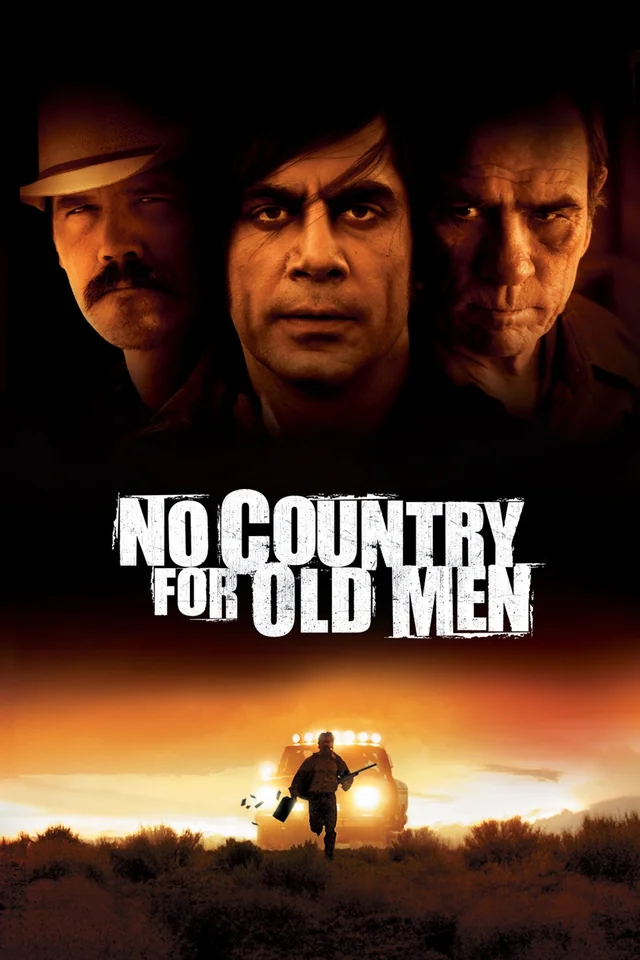
No Country for Old Men
Spare, fatalistic, darkly humorous, existentially bleak with moments of dry wit
Based on a publicly circulated draft of this screenplay sourced online — it may differ from the official shooting script or final film. Shown to demonstrate ProofIntelligence.
When a Vietnam veteran stumbles upon two million dollars at a drug deal gone wrong in the West Texas desert, he sets off a relentless chain of violence as a psychopathic killer and an aging sheriff each pursue the money — and confront the unstoppable nature of fate.
Executive Summary
No Country for Old Men is a rare screenplay that delivers both visceral genre thrills and profound philosophical depth, offering three A-list roles in a manageable mid-budget production. The Coen Brothers' adaptation of McCarthy's novel is production-ready, with a clear commercial hook (relentless cat-and-mouse thriller) wrapped around an awards-caliber meditation on fate and mortality. The primary investment risk — the protagonist's offscreen death and philosophical third act — is mitigated by the strength of the material, the casting opportunities, and the proven market for prestige crime narratives. With the right cast attached, this is a strong candidate for both theatrical release and awards-season positioning, with significant streaming afterlife value.
Why this verdict
This is an exceptional adaptation that translates McCarthy's sparse, philosophical prose into a taut, structurally daring screenplay. The Coens achieve a rare feat: a genre-defying crime thriller that operates simultaneously as a meditation on fate, morality, and the passage of time. The dialogue is among the finest in modern American cinema — every line is purposeful, character-specific, and loaded with subtext. The unconventional structure (protagonist killed offscreen, no traditional climax) is a bold artistic choice that deepens thematic resonance rather than undermining narrative satisfaction.
Score Breakdown
Casting
Josh Brolin
as MOSS
Brolin's weathered physicality and blue-collar authenticity make him ideal for a Vietnam veteran turned welder. His work in films like Milk and Oldboy demonstrates the range needed for Moss's journey from confident hunter to desperate prey.
Javier Bardem
as CHIGURH
Bardem's ability to project menace through stillness and his facility with philosophical dialogue make him uniquely suited to Chigurh's alien calm. His physical presence — tall, imposing, with distinctive features — creates the mythic quality the role demands.
Tommy Lee Jones
as BELL
Jones's lived-in Texas authenticity and world-weary gravitas are perfect for Bell's philosophical lawman. His ability to convey deep emotion through understatement — as demonstrated in The Fugitive and In the Valley of Elah — matches Bell's restrained anguish.
Woody Harrelson
as WELLS
Harrelson's natural charisma and affable confidence would make Wells's death more shocking. His ability to project competence while maintaining likability — seen in Natural Born Killers and True Detective — fits Wells's role as the doomed professional.
Kelly Macdonald
as CARLA JEAN
Macdonald's naturalistic acting style and ability to convey quiet strength would ground Carla Jean's practical warmth. Her work in Trainspotting and Boardwalk Empire shows she can hold the screen against powerful male co-stars while maintaining emotional authenticity.
Pacing & Rhythm
Overall pace
Deliberately measured with explosive bursts of violence
The pacing curve is deliberately unconventional — it peaks in the middle of the screenplay (Eagle Pass sequence, pages 58-65) rather than at the climax. The third act progressively decelerates, replacing physical action with philosophical reflection. This mirrors the thematic content: the world's violence doesn't build to a satisfying crescendo but simply continues, indifferent to narrative expectations. The Coens use the first two acts to earn the audience's trust through genre thrills, then spend the third act subverting those expectations. The result is a pacing profile that looks 'wrong' on paper but feels profoundly right in execution.
SLOW · pp. 18–24
The gas station coin toss scene between Chigurh and the Proprietor
Fix: This is intentionally slow — the tension comes from the deceleration itself. No change needed; it's one of the screenplay's signature scenes.
SLOW · pp. 106–110
Bell's extended conversation with Ellis about Uncle Mac and the nature of the country
Fix: While thematically essential, this scene could be tightened by 1-2 pages without losing its philosophical weight. Some of the back-and-forth about cats is charming but slightly indulgent.
RUSHED · pp. 99–100
Moss's death occurs entirely offscreen — we arrive at the aftermath
Fix: This is a deliberate artistic choice, not a pacing flaw. However, some readers/viewers may feel cheated. The screenplay earns this choice through its thematic commitment to Bell's perspective.
RUSHED · pp. 112–113
Carla Jean's confrontation with Chigurh and his subsequent car accident happen in rapid succession
Fix: The Carla Jean scene could benefit from slightly more breathing room before the tonal shift to the accident. The juxtaposition is thematically purposeful but emotionally abrupt.
Conflict Escalation
The conflict escalation follows an unconventional but brilliantly effective pattern. Tension builds in waves rather than a single ascending line — each location change (desert, Del Rio, Eagle Pass, El Paso) creates a new peak. The Eagle Pass sequence (pages 58-66) represents the screenplay's sustained tension peak. The radical decision to have the climactic violence occur offscreen creates a unique tension profile where the third act operates on existential rather than physical tension. The motel room scene where Bell may encounter Chigurh is the true climax — tension through stillness rather than action.
Peak moment · page 63
The Eagle Pass street chase — Moss commandeers a pickup while under fire, the driver is killed, Moss drives blind under sustained gunfire, then doubles back for a shotgun confrontation with Chigurh. The most sustained and visceral action sequence in the screenplay.
Protagonist Arc
Moss's arc is deliberately incomplete — a downward trajectory from confident hunter to hunted prey, terminated by death before any transformation can occur. This is the screenplay's most radical statement: competence, courage, and determination are not enough. The arc peaks early (finding the money) and then descends relentlessly, with brief plateaus of false security (motel preparations, hospital recovery) that are always shattered. Bell's arc, which takes over in Act Three, moves from despair (-60 at Moss's death) to a kind of acceptance (the dream), providing the emotional resolution that Moss's arc cannot.
Scene Audit
40 scenes evaluated — tension, pacing contribution, and whether each earns its place.
| Pg | Scene | Purpose | Tension | Verdict |
|---|---|---|---|---|
| 1 | EXT. MOUNTAINS / WEST TEXAS LANDSCAPE BELL | Establishes thematic framework through voiceover — incomprehensible evil, the old vs. newMasterful opening — sets philosophical tone for entire film | 15decelerates | essential |
| 3 | INT. SHERIFF LAMAR'S OFFICE CHIGURH | Introduces Chigurh through brutal escape — establishes his lethality and resourcefulnessVisceral introduction — Chigurh's nature shown, not told | 55accelerates | essential |
| 4 | EXT. ROAD CHIGURH · MAN | Chigurh's first use of the air gun — establishes his method and cold demeanorAir gun becomes signature weapon — chilling efficiency | 50maintains | essential |
| 5 | EXT. ARID PLAIN MOSS | Introduces Moss as hunter — establishes competence, patience, and the West Texas worldParallel to Chigurh's hunting — both are predators | 20decelerates | essential |
| 7 | EXT. BASIN MOSS · MAN | Moss discovers drug massacre — inciting incident that sets entire plot in motionMasterful slow reveal of carnage — tension builds perfectly | 50accelerates | essential |
| 10 | EXT. ROCK SHELF MOSS | Moss finds the money — the MacGuffin that drives the entire narrativePatient scene — Moss waits for shadow to confirm death | 45maintains | essential |
| 11 | INT. TRAILER MOSS · CARLA JEAN | Establishes Moss-Carla Jean relationship — love expressed through banterEfficient character work — relationship in six exchanges | 20decelerates | essential |
| 13 | INT. TRAILER KITCHEN MOSS · CARLA JEAN | Moss decides to return with water — the fatal moral choiceCatalyst scene — compassion becomes his undoing | 40accelerates | essential |
| 15 | EXT. BASIN MOSS | Moss discovered by drug runners — chase sequence beginsExplosive shift from quiet to lethal — perfectly timed | 80accelerates | essential |
| 17 | EXT. RIVER GORGE MOSS | River chase and dog fight — Moss barely survivesSustained action — establishes Moss's survival skills | 85accelerates | essential |
| 18 | INT. GAS STATION/GROCERY CHIGURH · PROPRIETOR | Coin toss scene — establishes Chigurh's philosophy of fate and chanceIconic scene — tension through dialogue alone | 70decelerates | essential |
| 25 | EXT. CATTLEGUARD ROAD CHIGURH · MAN · DRIVER | Chigurh visits crime scene with associates, then kills themEstablishes Chigurh eliminates all witnesses | 65maintains | essential |
| 28 | EXT. CATTLEGUARD ROAD / BASIN BELL · WENDELL | Bell and Wendell investigate the massacre — establishes Bell's methodologyDark humor balances horror — 'managerial' line is gold | 35decelerates | essential |
| 32 | INT. MOSS' TRAILER CHIGURH | Chigurh searches Moss's trailer — drinks milk, takes phone billChilling domesticity — Chigurh's calm is terrifying | 55maintains | essential |
| 35 | INT. MOSS' TRAILER BELL · WENDELL | Bell discovers sweating milk — just missed ChigurhBrilliant detail — milk as ticking clock | 50maintains | essential |
| 38 | INT. MOTEL ROOM MOSS | Moss hides money in airduct — establishes his resourcefulnessSetup for later duct retrieval — Chekhov's airduct | 35maintains | essential |
| 45 | INT. SPORTING GOODS STORE MOSS · CLERK | Moss buys shotgun and tent poles — preparation montageTent poles setup pays off brilliantly later | 25maintains | essential |
| 47 | INT. 2ND MOTEL ROOM / CHIGURH'S TRUCK MOSS · CHIGURH | Parallel preparation — Moss builds retrieval tool as Chigurh closes inMasterful cross-cutting builds unbearable suspense | 75accelerates | essential |
| 50 | EXT./INT. 1ST MOTEL ROOM CHIGURH | Chigurh kills Mexicans in Moss's old room — Moss hears through ductPeak tension — violence heard not seen by Moss | 90accelerates | essential |
| 54 | INT. OFFICE WELLS · MAN | Wells hired to find Chigurh and recover money — introduces new playerEfficient exposition — Wells's confidence is ominous | 40decelerates | essential |
| 58 | INT. HOTEL ROOM MOSS | Moss discovers transponder — Chigurh arrives at doorDevastating revelation — the money was always tracked | 85accelerates | essential |
| 60 | EXT. HOTEL EAGLE SIDEWALK MOSS · CHIGURH | Moss escapes hotel — running gunfight through Eagle PassSustained action masterpiece — geography is crystal clear | 92accelerates | essential |
| 65 | EXT. RIO GRANDE BRIDGE MOSS | Wounded Moss crosses border — buys shirt from youths, throws case over fenceResourcefulness under extreme duress — character-defining | 65maintains | essential |
| 68 | EXT. MEXICAN SQUARE MOSS | Moss collapses in Mexican square — mariachis find himDark humor meets desperation — tonal mastery | 40decelerates | essential |
| 69 | INT. RAMCHARGER / PHARMACY CHIGURH | Chigurh treats his own wound — blows up car as distraction to steal drugsHumanizes Chigurh — he bleeds, he hurts, he adapts | 50maintains | essential |
| 73 | INT. HOSPITAL ROOM MOSS · WELLS | Wells warns Moss about Chigurh — offers deal for the moneyCrucial exposition — Chigurh's nature explained | 45decelerates | essential |
| 77 | INT. COFFEE SHOP ODESSA BELL · CARLA JEAN | Bell tries to reach Moss through Carla Jean — Charlie Walser storyBell's folksy wisdom masks genuine desperation | 30decelerates | essential |
| 80 | INT. 2ND HOTEL EAGLE ROOM CHIGURH · WELLS | Chigurh kills Wells — 'of what use was the rule' confrontationPhilosophical climax — eliminates last hope for Moss | 85accelerates | essential |
| 82 | INT. MEXICAN HOSPITAL / HOTEL EAGLE MOSS · CHIGURH | Phone call — Chigurh threatens Carla Jean, Moss vows revengeStakes raised to maximum — Carla Jean now targeted | 80maintains | essential |
| 91 | INT. OFFICE HALLWAY / OFFICE CHIGURH · MAN AT CHAIR | Chigurh kills the man who hired Wells — eliminates the chain of commandChigurh operates outside all hierarchies | 60maintains | essential |
| 93 | INT. CAB / BUS STATION CARLA JEAN · MOTHER | Carla Jean and Mother travel to El Paso — Mother's complaints provide dark humorMother's comedy slightly overextended — trim by half page | 20decelerates | needs_work |
| 97 | EXT. MOTEL EL PASO MOSS · WOMAN | Moss flirts with poolside woman — humanizing moment before deathPoignant calm before the storm — Moss still alive | 25decelerates | essential |
| 99 | EXT. MOTEL COURTYARD BELL · MOSS | Bell arrives to find Moss dead — the anti-climaxDevastating — protagonist's death denied to audience | 75accelerates | essential |
| 101 | INT. COFFEE SHOP EL PASO BELL · ROSCOE | Bell and Roscoe discuss the violence — 'dismal tide' conversationThematic processing — two old men confronting chaos | 25decelerates | essential |
| 103 | EXT./INT. MOTEL ROOM BELL · CHIGURH | Bell enters motel room — Chigurh may be inside. The true climax.Existential climax — tension through stillness and reflection | 78maintains | essential |
| 106 | INT. WEST TEXAS CABIN BELL · ELLIS | Ellis provides philosophical resolution — 'vanity' speechThematic thesis delivered — essential despite slow pace | 20decelerates | essential |
| 110 | EXT. GRAVESITE ODESSA CARLA JEAN | Mother's funeral — time has passed, Carla Jean aloneSets up final Chigurh confrontation with quiet grief | 15decelerates | essential |
| 111 | INT. BEDROOM CARLA JEAN · CHIGURH | Chigurh fulfills his promise — Carla Jean refuses the coinDevastating — Carla Jean's moral stand against fate | 72maintains | essential |
| 113 | EXT. INTERSECTION CHIGURH | Chigurh T-boned by random driver — fate strikes the fatalistIronic justice — Chigurh subject to the randomness he preaches | 55accelerates | essential |
| 115 | INT. BELL'S KITCHEN BELL · LORETTA | Bell recounts his dreams — final image mirrors openingPerfect ending — fire in the horn, meaning in darkness | 10decelerates | essential |
Beat Sheet · Save The Cat
The screenplay follows the Save the Cat structure more closely than its reputation for unconventionality might suggest — all fifteen beats are present and identifiable. However, the timing is significantly compressed in the first half (catalyst and break into two arrive early) and stretched in the second half (All Is Lost and Dark Night occur much later than expected). The most radical departure is that the 'All Is Lost' moment is permanent — the protagonist actually dies, and the remaining beats belong to a different character (Bell). This structural transfer from Moss to Bell as the emotional protagonist is the screenplay's most daring innovation and the reason it transcends genre.
| Beat | Expected | Actual | Present | Quality |
|---|---|---|---|---|
Opening Image Snow-covered mountains and West Texas landscapes — Bell's voiceover establishes a world of incomprehensible violence and aging lawmen | p. 1 | p. 1 | 98 | |
Theme Stated Bell's voiceover: 'I don't want to push my chips forward and go out and meet something I don't understand' — the fear of confronting evil beyond comprehension | p. 5 | p. 2 | 95 | |
Setup Moss hunting antelope, discovering the massacre, finding the money — establishes his world, skills, and the temptation | p. 10 | p. 5 | 95 | |
Catalyst Moss decides to return to the desert with water for the dying man — the act of conscience that seals his fate | p. 12 | p. 13 | 98 | |
Debate Brief but present — Moss lying in bed, shaking his head, debating whether to go back. 'I'm fixin' to do somethin' dumbern hell but I'm goin' anyways.' | p. 15 | p. 12 | 85 | |
Break Into Two Moss is discovered at the basin and the chase begins — he is now irrevocably in the world of violence and pursuit | p. 25 | p. 15 | 92 | |
B Story Bell and Wendell's investigation — the philosophical/thematic counterpoint to Moss's physical journey | p. 30 | p. 28 | 90 | |
Fun and Games Moss's resourceful preparations — hiding money in airducts, buying shotguns, building retrieval tools from tent poles. The 'promise of the premise' is a man using his wits against an unstoppable force. | p. 37 | p. 38 | 92 | |
Midpoint Moss discovers the transponder and realizes he's been tracked all along — false defeat that triggers the Eagle Pass shootout | p. 55 | p. 58 | 95 | |
Bad Guys Close In Wells visits Moss in hospital warning him; Chigurh kills Wells; Chigurh calls Moss threatening Carla Jean — all avenues of escape are closing | p. 65 | p. 73 | 90 | |
All Is Lost Moss is killed offscreen at the El Paso motel — the most radical 'All Is Lost' in modern cinema, as it's permanent and denied to the audience | p. 75 | p. 99 | 88 | |
Dark Night of the Soul Bell at the coffee shop with Roscoe, then at the motel room — confronting his failure to save Moss and his inability to comprehend the violence | p. 80 | p. 101 | 90 | |
Break Into Three Bell visits Ellis — receives the wisdom that allows him to accept his limitations. 'You can't stop what's comin. Ain't all waitin' on you.' | p. 85 | p. 106 | 95 | |
Finale Chigurh fulfills his promise to Carla Jean, then is injured in a random accident — fate operates on everyone, even its agent. Bell retires. | p. 100 | p. 111 | 88 | |
Final Image Bell's dream of his father carrying fire through the mountains — a mirror of the opening image, transformed from dread to quiet hope | p. 110 | p. 116 | 98 |
What's Working
Dialogue of the Highest Order
Every character speaks with a distinct, authentic voice. The coin toss scene, the Wells-Chigurh confrontation, and Bell's philosophical musings are among the finest dialogue writing in modern cinema. The Coens capture McCarthy's vernacular while adding their own rhythmic precision.
Iconic Antagonist
Chigurh is a once-in-a-generation villain — terrifying, philosophically coherent, and mythically resonant. His coin-toss philosophy elevates him from mere psychopath to an allegorical force, making the screenplay's themes visceral rather than abstract.
Thematic Unity
Every scene, character, and plot beat serves the central meditation on fate, mortality, and the limits of human agency. The structure itself embodies the theme — the protagonist's offscreen death demonstrates that the universe does not arrange itself around human narratives.
Three-Star Vehicle
The screenplay offers three meaty, awards-caliber roles that would attract top-tier talent. Each character operates in a different register (action hero, philosophical villain, contemplative lawman), providing range and variety for casting and marketing.
Genre-Prestige Hybrid
Rare ability to function as both a visceral crime thriller and a philosophical meditation, giving it dual-market appeal — genre audiences for the chase, cinephiles for the ideas. This duality maximizes both theatrical and awards potential.
What to Fix
Offscreen Protagonist Death
Moss's death occurring offscreen is the screenplay's most divisive choice. While thematically justified (the universe doesn't arrange climaxes for our benefit), it risks alienating audiences who have invested emotionally in his survival. Some viewers will feel the narrative contract has been broken.
Third Act Pacing Shift
The transition from high-octane chase thriller to philosophical meditation in the final 20 pages is jarring. Bell's conversations with Roscoe and Ellis, while thematically rich, represent a significant deceleration that may lose viewers expecting a conventional resolution.
Limited Female Agency
Carla Jean, while well-drawn, functions primarily as a stake in the male characters' conflict. Her final scene with Chigurh gives her moral agency, but she has limited ability to affect the plot. The Mother is played entirely for comic relief. In the current market climate, this may draw criticism.
Extreme Violence Limits Audience
The graphic violence — strangling, multiple shootings, implied torture — limits the potential audience significantly. While essential to the story's impact, it restricts family viewership and may face censorship challenges in certain markets.
Rewrite priorities
Add 2-3 brief scenes of Carla Jean in Odessa — dealing with her mother, worrying, perhaps taking some protective action — to maintain her presence and deepen the audience's connection before her final scene
Issue: Carla Jean disappears for most of Act Two, reducing emotional investment in her fate
Consider a brief, fragmented glimpse of the motel confrontation — even just sound design or a flash — before cutting to Bell's arrival. This preserves the thematic point while giving the audience a sliver of closure.
Issue: Moss's offscreen death may feel like a cheat to some audiences despite thematic justification
Trim the opening cat banter by half a page to get to the philosophical meat faster. The Uncle Mac story and 'vanity' line are the scene's purpose — arrive there sooner.
Issue: The Ellis scene, while thematically essential, runs slightly long with the cat discussion
Consider one additional scene establishing Wells's competence before his encounter with Chigurh — perhaps showing him successfully tracking someone else — to make his death more shocking
Issue: Wells is introduced and killed within a relatively compressed span, limiting his impact
Reduce the Mother's lines in the phone call scene by one or two — keep her presence but let the Moss-Carla Jean exchange breathe more
Issue: The Mother's comic interjections occasionally undercut dramatic tension
Biggest improvement lever
While this is a near-perfect screenplay, the single biggest improvement lever would be expanding Carla Jean's role in Act Two to give her more agency and screen presence before her devastating final scene. Currently, she disappears for long stretches, which makes her death feel more like a plot device than the culmination of a character arc. Even 2-3 additional scenes showing her grappling with the situation — perhaps actively trying to find Moss or making her own preparations — would deepen the emotional impact of her final confrontation with Chigurh and address the screenplay's most significant structural gap.
Emotional Rhythm
The emotional rhythm is predominantly negative-valence but remarkably varied within that range. The Coens masterfully deploy dark humor (Bell and Wendell's banter, the Mother's complaints) as pressure-release valves between sequences of intense dread. The emotional low point is Moss's offscreen death and Carla Jean's reaction — devastating precisely because of its understatement. The final dream sequence achieves something rare: a sense of peace that doesn't negate the preceding darkness but transcends it. The screenplay's emotional genius is in making bleakness feel earned rather than nihilistic.
Act Structure
Act One
pp. 1–25Sheriff Bell's voiceover establishes the thematic framework of incomprehensible evil. Moss discovers the drug deal massacre, takes the money, and returns with water for the dying man — a fatal act of conscience that exposes him. Chigurh escapes custody, kills, and begins his pursuit. Moss sends Carla Jean to Odessa and flees.
Key turning point
Moss's decision to return to the desert with water, which alerts the drug runners to his identity and sets the entire pursuit in motion.
A masterfully constructed first act that establishes three parallel storylines with remarkable economy. The inciting incident (finding the money) occurs early, and the true catalyst — Moss's return with water — is a brilliant character choice that makes the entire plot hinge on a moment of compassion. The act efficiently introduces all three principals and their worldviews.
Act Two
pp. 25–100A relentless cat-and-mouse pursuit across West Texas. Chigurh tracks Moss via transponder through Del Rio motels, Eagle Pass, and across the Mexican border. Carson Wells is hired to recover the money but is killed by Chigurh. Bell investigates but is always one step behind. Moss is wounded, recovers in Mexico, and arranges to meet Carla Jean in El Paso. The act culminates in Moss's offscreen death at the motel.
Key turning point
Moss discovers the transponder in the money case at the Hotel Eagle, which shifts the chase dynamic — but Chigurh's phone call threatening Carla Jean raises the stakes to their highest point.
The second act is a sustained masterclass in tension escalation. Each location change ratchets up the danger. The Coens make the radical choice to kill the protagonist offscreen, which is the screenplay's most daring structural gambit. The Wells subplot efficiently introduces and eliminates a potential savior, deepening the sense of inevitability. Bell's parallel investigation provides philosophical counterpoint to the visceral chase.
Act Three
pp. 100–117Bell confronts the aftermath of Moss's death, visits the crime scene where Chigurh may still be present, and retires. Chigurh fulfills his promise to kill Carla Jean, then is injured in a random car accident. Bell visits Ellis, who contextualizes the violence as eternal. Bell retires and recounts two dreams about his father to Loretta.
Key turning point
Bell's visit to Ellis, where Ellis tells him 'You can't stop what's comin. Ain't all waitin' on you' — the thematic thesis of the entire film.
A profoundly unconventional third act that replaces climactic action with philosophical reckoning. Bell's motel room scene — where Chigurh may or may not be behind the door — is the true climax, a moment of existential confrontation rather than physical. The final dream monologue is one of the great endings in American screenwriting, circling back to the opening's meditation on time and mortality.
Midpoint · page 58
Moss discovers the transponder hidden in the money at the Hotel Eagle, realizing he has been tracked all along. Chigurh arrives at his door, and the ensuing shootout forces Moss across the border into Mexico, gravely wounded.
This is a devastating midpoint that transforms Moss from hunter to hunted. The discovery of the transponder is a false victory — knowledge that comes too late. The Eagle Pass sequence is the screenplay's most sustained action set piece and marks the point where Moss's survival becomes genuinely uncertain. The stakes shift from 'can he keep the money' to 'can he survive at all.'
Character Analysis
Protagonist · arc 70/100
MOSS
want
To keep the two million dollars and protect his wife Carla Jean
need
To recognize that some forces cannot be outrun or outfought — that his competence has limits
flaw
Stubborn self-reliance and pride that prevents him from accepting help or recognizing when he's outmatched
Moss is a brilliantly drawn protagonist precisely because his arc is incomplete by design. He is competent, resourceful, and brave — qualities that in a conventional thriller would save him. The screenplay's radical insight is that these qualities are insufficient against the force Chigurh represents. His one moment of moral weakness (taking the money) and his one moment of moral strength (returning with water) both contribute to his destruction.
Antagonist · threat 98/100
CHIGURH
One of the most iconic antagonists in modern cinema. Chigurh operates as both a realistic hitman and an allegorical figure of death/fate. His coin-toss philosophy gives him a terrifying internal logic — he is not random but operates by principles that are alien and absolute. The screenplay never explains his origins or motivations beyond his own stated philosophy, which makes him more frightening. His injuries (leg wound, car accident) humanize him just enough to prevent him from becoming a cartoon.
Supporting cast
18 characters · 15 distinct voicesThe supporting cast is remarkably well-differentiated despite many characters appearing in only one or two scenes. The Coens give each character a distinct verbal rhythm — the Proprietor's nervous deference, the Mother's querulous complaints, the INS Official's drill-sergeant cadence. Even unnamed characters (the Woman at the pool, the Boys after the car accident) have vivid, specific voices. This is a screenplay where no character speaks in a generic way.
Character Presence
Screen presence by act; total scene count on the right.
Dialogue
Subtext
Voice
Density: Medium — alternates between dialogue-heavy scenes and long stretches of near-silent action
The dialogue is among the finest in modern American screenwriting. Every character has a distinct verbal fingerprint — Chigurh's flat, philosophical precision; Moss's laconic cowboy wit; Bell's folksy wisdom laced with genuine anguish; Carla Jean's practical directness. The Coens preserve McCarthy's ear for West Texas vernacular while shaping it for dramatic rhythm. The coin toss scene and the Chigurh-Wells confrontation are masterclasses in dialogue-as-tension. Subtext is extraordinarily high — nearly every conversation is about something other than its surface subject.
The balance shifts dramatically across acts, which is one of the screenplay's most distinctive features. Act One is action-heavy (desert discovery, chase, river crossing) with minimal dialogue. Act Two balances dialogue and action as the cat-and-mouse game plays out through both conversation and violence. Act Three is overwhelmingly dialogue-driven as the screenplay transitions from thriller to philosophical meditation. This progressive shift from action to dialogue mirrors the thematic movement from physical conflict to existential reckoning.
Notable lines
“What's the most you've ever lost on a coin toss?”
CHIGURH · page 22
The line that crystallizes Chigurh's entire philosophy — fate as currency, life as a wager you didn't know you were making.
“If the rule you followed brought you to this, of what use was the rule?”
CHIGURH · page 81
Devastating philosophical challenge to Wells that doubles as the screenplay's central question about moral codes and their utility.
“You can't stop what's comin. Ain't all waitin' on you. That's vanity.”
ELLIS · page 110
The thematic thesis delivered with perfect economy — Bell's despair reframed as a form of egotism.
“If I don't come back tell Mother I love her. / Your mother's dead, Llewelyn. / Well then I'll tell her myself.”
MOSS · page 13
Establishes Moss's gallows humor and his relationship with Carla Jean in three lines — love expressed through banter.
“I don't want to push my chips forward and go out and meet something I don't understand.”
BELL · page 2
Opening voiceover line that establishes Bell's central conflict — the fear not of death but of incomprehension.
Lines to fix
“Ultimo hombre. Last man standing, must've been one.”
MOSS · page 8
Slightly on-the-nose translation for the audience's benefit. Moss's Spanish feels performative rather than natural — though this may be intentional characterization of his limited Spanish.
“There is falseness in his voice!”
MOTHER · page 90
The Mother's comic interjections risk undercutting the tension of the phone call. While tonally consistent with the Coens' style, this particular line pushes toward caricature.
Market & Audience
This screenplay occupies the rare sweet spot between prestige cinema and commercial thriller. Its West Texas setting keeps production costs manageable (mid-budget ₹15-25Cr equivalent in Indian terms, or $25-35M in Hollywood). The three-hander structure demands star casting in all three leads, which is both a packaging challenge and an opportunity. The material is inherently awards-friendly while delivering enough genre thrills for commercial viability. In the current market, this would be a strong theatrical release with massive streaming afterlife.
Audience
Cinephiles, adult thriller audiences, literary adaptation enthusiasts aged 25-55
Budget band
mid
Trend
Neo-Westerns and border crime narratives have proven durable in both theatrical and streaming markets, with sustained interest post-Sicario and Yellowstone era
Platforms
Theatrical (prestige wide release) · Premium OTT (Netflix, Amazon Prime) · Awards circuit
The screenplay's primary audience is the prestige/cinephile segment — it is designed to reward close attention and philosophical engagement. However, its genre elements (chase sequences, gunfights, iconic villain) give it significant crossover appeal to mainstream thriller audiences, particularly on streaming platforms where word-of-mouth can build over time. Youth appeal is moderate — the action sequences and Chigurh's iconic status attract younger viewers, but the meditative third act may test patience. Family appeal is minimal due to extreme violence. The ideal release strategy is a prestige theatrical launch targeting awards season, followed by wide streaming availability.
Risks · Moderate
- • Protagonist dies offscreen in the third act — audiences expecting conventional resolution may feel cheated
- • Philosophical/meditative third act replaces action climax — pacing shift may lose mainstream viewers
- • Extremely violent content limits family audience
- • No female lead with significant agency until the final Carla Jean scene
- • Bleak, fatalistic worldview with no conventional 'victory'
Mitigations
- • Star casting in all three leads mitigates structural risk — audiences will follow actors they trust
- • Genre packaging (crime thriller marketing) can draw audiences who then receive a deeper experience
- • Awards potential creates prestige value that extends commercial life
- • Source material (McCarthy novel) provides built-in literary audience
- • The Coens' track record demonstrates that unconventional narratives can achieve both critical and commercial success
Investment Case
Franchise Potential
standalone- Chigurh's backstory and continued operations could theoretically support a prequel
- The West Texas border world and drug trade ecosystem could support anthology-style stories
This is emphatically a standalone work. Its power derives from its finality — Bell retires, Moss dies, Chigurh limps away. A sequel would undermine the thematic completeness. While the world is rich enough to support other stories (the Coens' own filmography proves West Texas crime is an inexhaustible well), this particular narrative is complete. Any franchise extension would be a commercial calculation, not an artistic one.
International Viability
The screenplay's themes are universal — death, fate, aging, moral compromise — even as its setting is hyper-specific. The Coens' international reputation ensures strong festival and arthouse performance globally. The crime thriller elements provide commercial hooks that transcend cultural barriers. McCarthy's literary reputation adds prestige value in markets that value literary adaptations. The main barrier is the dialogue-heavy, philosophically dense third act, which requires cultural patience that varies by market.
Strong markets: United States (primary), United Kingdom, France (strong Coen Brothers following), Germany, Japan (appreciation for philosophical crime narratives), South Korea, Australia, Scandinavia
Cultural barriers: Deeply specific West Texas vernacular may challenge non-English audiences in translation; The philosophical third act requires patience that some international audiences may not extend to an American Western; The gun culture and border-specific context may not resonate universally
Investment Readiness
low riskReady for packagingThis screenplay is exceptionally investment-ready. It offers three star-making roles, a manageable budget (primarily location shooting in West Texas), proven source material (bestselling McCarthy novel), and the Coen Brothers' track record of critical and commercial success. The unconventional structure is the primary risk factor, but the genre packaging (crime thriller) provides commercial insurance. Awards potential is extremely high, which extends the commercial window significantly. The screenplay requires minimal rewriting — it is production-ready as written.
Attachment suggestions
- • A-list actor for Chigurh (physically imposing, capable of stillness and menace)
- • A-list actor for Moss (rugged, physical, everyman quality)
- • A-list character actor for Bell (gravitas, warmth, world-weariness)
- • Experienced cinematographer specializing in landscape and natural light (Roger Deakins caliber)
- • Director with proven ability to balance genre thrills with philosophical depth
Comparable Films
Fargo (1996)
Same filmmakers deploying dark humor within a crime narrative, with a philosophical lawman protagonist who cannot comprehend the evil he encounters.
Blood Simple (1984)
The Coens' debut shares the Texas noir setting, the suitcase-of-money MacGuffin, and the theme of ordinary people destroyed by greed and violence.
Hell or High Water (2016)
Modern West Texas setting, aging lawman pursuing desperate men, meditation on economic desperation and the death of the old West.
Sicario (2015)
Border-region crime thriller exploring the futility of fighting an unstoppable tide of violence, with a protagonist overwhelmed by forces beyond their control.
The Counselor (2013)
Another McCarthy adaptation exploring how a single decision to enter the drug trade triggers an irreversible chain of consequences and philosophical confrontation with death.
Cinema DNA
The directorial sensibilities this script most resembles, weighted by influence.
✦Your Cinema DNA
Shares the meditative pacing, vast Texas landscapes, and philosophical underpinning of crime narratives — A Ghost Story and Ain't Them Bodies Saints operate in similar existential territory.
The sprawling crime narrative with philosophical depth, unflinching violence, and morally complex characters mirrors Gangs of Wasseypur's approach to crime as existential commentary.
The spare, fatalistic worldview, the mythic quality of violence, and the philosophical dialogue are pure McCarthy filtered through the Coens' dark humor and structural precision — this IS the definitive Coen-McCarthy synthesis.
The verdict, in full
No Country for Old Men is a masterful adaptation by Joel and Ethan Coen of Cormac McCarthy's novel, functioning simultaneously as a taut crime thriller and a profound philosophical meditation on fate, mortality, and the limits of human agency. The screenplay follows three parallel trajectories: Llewelyn Moss, a Vietnam veteran who discovers two million dollars at a drug massacre; Anton Chigurh, a psychopathic killer pursuing the money with terrifying philosophical conviction; and Sheriff Ed Tom Bell, an aging lawman who investigates the carnage while confronting his own obsolescence. The dialogue is extraordinary — the coin toss scene and Chigurh-Wells confrontation rank among the finest in modern cinema. The screenplay's most radical choice — killing its protagonist offscreen and replacing a conventional climax with philosophical conversation — is both its greatest artistic achievement and its most commercially risky element. The final dream monologue is a haunting, perfectly crafted ending that reframes the entire narrative as a meditation on the passage of time and the persistence of meaning in a violent world.
Your screenplay deserves this.
Every section you just read — scores, cast, pacing curves, scene-by-scene audit, market read, and a producer-ready verdict — generated for your script in minutes.
Registered with tamper-proof timestamps · Yours alone
Analysis of a publicly available draft of this screenplay sourced online. It may differ from the official shooting script or final film. Shown to demonstrate ProofIntelligence — not an official or licensed screenplay.