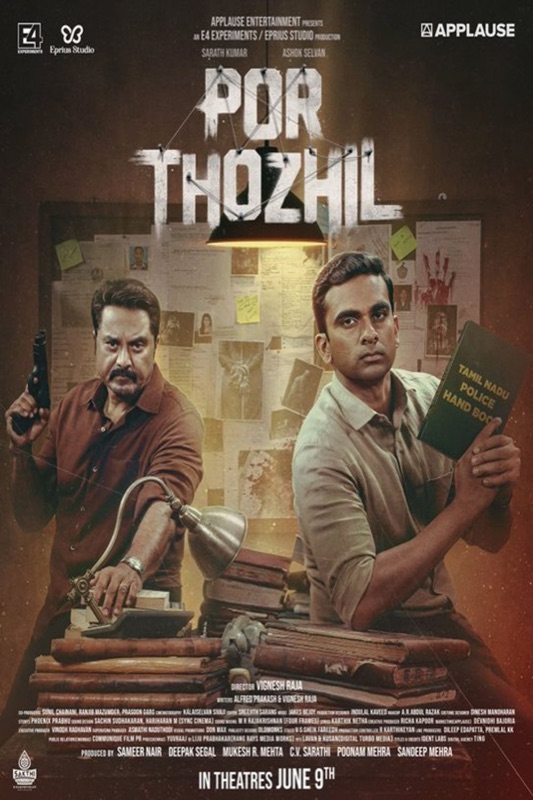
Por Thozhil
Dark, tense, and emotionally layered with moments of dry humor and warmth
Based on a publicly circulated draft of this screenplay sourced online — it may differ from the official shooting script or final film. Shown to demonstrate ProofIntelligence.
A fearful rookie police officer is paired with a hardened, emotionally closed-off senior SP to hunt a serial killer in Trichy, only to discover that the murders span generations — and that the line between those who destroy and those who protect is thinner than either imagined.
Executive Summary
Por Thozhil is a commercially viable serial killer procedural with genuine emotional depth — a rare combination in Tamil cinema. The dual-hero structure (veteran SP + rookie DSP hunting a serial killer in Trichy) provides flexible casting opportunities for both an established star and a breakout talent, while the investigation's dual-twist structure delivers the kind of interval-point surprise and climactic revelation that drives word-of-mouth. At an estimated ₹15-25Cr budget with Trichy locations, the risk-reward ratio is favorable — the genre has proven ₹100Cr+ potential (Ratsasan) and the OTT rights market for dark crime content is robust. The script needs one polish pass (strengthen the unnamed killer, give VEENA more agency, tighten the flashback) but the foundational storytelling is strong enough to begin packaging immediately with a director attachment.
Why this verdict
Por Thozhil delivers a compelling serial killer procedural with a layered mentor-protégé dynamic between ARYAN and PRAKASH that anchors the emotional core. The screenplay demonstrates strong structural command with a well-executed midpoint reveal (Kennedy as suspect), a genuinely surprising second-half twist (Kennedy is not the current killer), and a thematically resonant ending. The concept of intergenerational trauma producing both killers and cops is potent and commercially viable. Some craft elements — particularly scene description economy and formatting discipline — need polish, but the storytelling instincts are strong enough for serious production consideration.
Score Breakdown
Casting
R. Madhavan
as ARYAN
Madhavan has the physical presence (tall, well-built) and the acting range to play ARYAN's cold exterior with buried emotional depth. His work in Vikram Vedha demonstrated his ability to command screen presence in morally complex roles, and his age (mid-50s) fits the character perfectly.
Ashok Selvan
as PRAKASH
Ashok Selvan's boy-next-door appeal and ability to convey vulnerability make him ideal for PRAKASH. His performances in Oh My Kadavule and Sila Nerangalil Sila Manidhargal show he can balance humor with emotional depth, and his physical type (clean-shaven, youthful) matches the script's description.
Prakash Raj
as KENNEDY
Prakash Raj's extraordinary range — from menacing to heartbreaking — makes him the ideal KENNEDY. The confession sequence demands an actor who can make audiences simultaneously horrified by and sympathetic to a killer. His work across Tamil, Telugu, and Hindi cinema proves he can carry this complex, pivotal role.
Aishwarya Rajesh
as VEENA
Aishwarya Rajesh brings intelligence, warmth, and screen presence that would elevate VEENA beyond the page. Her performances in Kanaa and Ka Pae Ranasingam demonstrate her ability to play strong, educated women with emotional depth. She could also bring the star power needed to make VEENA's third-act abduction feel like genuine stakes.
Samuthirakani
as MARI
Samuthirakani's ability to convey raw, primal emotion in limited screen time makes him perfect for MARI. His daughter's death scene requires an actor who can devastate an audience in under two minutes. His work in Jai Bhim and Mersal proves he can deliver exactly this kind of gut-punch performance.
Pacing & Rhythm
Overall pace
Well-calibrated with one significant dip
The pacing curve demonstrates strong instincts for rhythm and momentum management. The screenplay builds steadily through Act One, accelerates through the investigation in Act Two, and delivers a relentless third act. Key pacing strengths: the briefing montage efficiently covers exposition, the false alarm in the cane field maintains tension even without a payoff, and the parallel cutting between ARYAN at Rockfort and the killer at Sangam is expertly paced. The main pacing concern is the Kennedy flashback sequence (pages 98-114), which creates a significant energy dip at a point where the story should be building toward its climax. This 16-page flashback, while emotionally powerful, interrupts the thriller momentum. Recommendation: trim to 10-12 pages by consolidating the abuse and killing montages.
SLOW · pp. 98–114
Kennedy's extended flashback sequence — childhood abuse, killing montages, and the revelation of the real killer's identity through Kennedy's account
Fix: Consolidate the montage sub-scenes (46A through 50) from 16 pages to 10-12. Combine the multiple killing montages into fewer, more impactful scenes. The emotional power is in the specifics, not the repetition.
SLOW · pp. 16–20
Airport meet-cute and travel to Trichy — charming but delays the investigation
Fix: Trim the airport scene by half a page and cut the Trichy entry montage entirely — we don't need landscape shots in a screenplay.
RUSHED · pp. 114–120
The real killer's introduction, preparation, and the team's discovery of his house happen in rapid succession without enough breathing room
Fix: Add one scene where the killer is observed in his daily routine before the team identifies him — this would build his character and create more dread before the climax.
RUSHED · pp. 129–134
The car chase, forest confrontation, ARYAN's stabbing, and PRAKASH's showdown all happen at breakneck speed
Fix: The pacing here is actually appropriate for a climax — the rush serves the tension. However, add 2-3 more beats to PRAKASH's internal decision to pick up the gun. This is the story's most important moment and deserves slightly more space.
Conflict Escalation
The conflict escalation follows an excellent trajectory with multiple peaks and valleys that prevent audience fatigue. The screenplay wisely builds tension through investigation mechanics in the first half, peaks devastatingly with MARI's daughter's death at the midpoint, then resets slightly before building again through the Kennedy infiltration sequence. The false resolution (wrong killer caught) provides a clever tension valley before the third act's relentless escalation. The peak moment — PRAKASH alone with the killer after ARYAN is incapacitated — is perfectly positioned and earns its intensity through 130 pages of character building. The only structural concern is that the Kennedy flashback sequence (pages 98-114) creates a significant tension dip at a point where momentum should be building toward the climax.
Peak moment · page 133
PRAKASH catches the thrown gun mid-air, clears the stove pipe malfunction, and empties the magazine into the killer — completing his transformation from fearful rookie to decisive officer
Protagonist Arc
PRAKASH's internal arc is beautifully crafted with a clear trajectory from fear to courage. The arc is not linear — it oscillates realistically, with moments of growing confidence (thermometer trick, archive discovery) punctuated by setbacks (cane field terror, Kennedy's attack). The critical inflection point is ARYAN's validation in the car (page 89), which gives PRAKASH the internal permission to be afraid AND brave simultaneously. The climactic moment — catching the gun and clearing the malfunction — is the perfect synthesis of his academy training (the skill) and his newfound courage (the will). The denouement adds a beautiful coda: PRAKASH's courage now extends beyond catching criminals to preventing the conditions that create them. This is a protagonist arc that would make any development executive take notice.
Scene Audit
40 scenes evaluated — tension, pacing contribution, and whether each earns its place.
| Pg | Scene | Purpose | Tension | Verdict |
|---|---|---|---|---|
| 1 | EXT - ROAD 1 SUB INSPECTOR · CONSTABLE | Establish tone, introduce radio letter that mirrors constable's life, discover first bodyAtmospheric prologue sets dark tone effectively | 40accelerates | essential |
| 3 | EXT - SECOND CRIME SCENE SUB INSPECTOR · CONSTABLE · CIRCLE INSPECTOR · ASSISTANT COMMISSIONER | Establish second murder with identical MO, introduce AC characterEfficiently establishes serial pattern and stakes | 50accelerates | essential |
| 7 | EXT - PRAKASH HOUSE PRAKASH · NEPHEW | Introduce PRAKASH's fear through bathroom scene, establish nephew relationshipSeeds PRAKASH's core flaw — fear — with humor | 10decelerates | essential |
| 8 | INT - PRAKASH HOUSE PRAKASH · PRAKASH'S MOTHER · NEPHEW | Family celebration, establish father's legacy, phone throw/catch setupGun-catch payoff seeded here — critical setup | 5decelerates | essential |
| 10 | INT - ADGP CABIN PRAKASH · ADGP | Establish PRAKASH's credentials and ARYAN's reputation through ADGPADGP's warmth contrasts ARYAN's coldness perfectly | 20maintains | essential |
| 12 | INT - SEMINAR HALL ARYAN · PRAKASH | ARYAN's dramatic introduction — hostile, commanding, intimidatingIconic character intro — attendance register throw | 45accelerates | essential |
| 16 | INT - CHENNAI AIRPORT PRAKASH · VEENA · ARYAN | Introduce VEENA, establish PRAKASH-VEENA chemistry, comic awkwardnessCharming but slightly long — trim by one page | 10decelerates | needs_work |
| 19 | EXT - TRICHY AIRPORT PARKING MARI · ARYAN · PRAKASH · VEENA | Introduce MARI, PRAKASH's first salute, seatbelt comedyMARI intro and first salute — warm character beat | 10maintains | essential |
| 20 | INT - CONFERENCE HALL ARYAN · PRAKASH · VEENA · ASSISTANT COMMISSIONER | AC briefs team on double murder case — full case expositionDense exposition handled through character conflict | 50accelerates | essential |
| 26 | INT - MORTUARY ARYAN · PRAKASH · DOCTOR | Autopsy details, PRAKASH vomits, ARYAN tells him to leaveCritical character test — PRAKASH's lowest point | 55accelerates | essential |
| 34 | EXT - SANGAM TERRACE PRAKASH · VEENA | VEENA calms PRAKASH, shares her backstory, motivates him to stayEmotional anchor scene — VEENA's purpose defined | 15decelerates | essential |
| 37 | EXT - SECOND CRIME SCENE ARYAN · PRAKASH | Role-play profiling — ARYAN teaches criminal psychology through simulationScreenplay's best scene — teaching through action | 60accelerates | essential |
| 40 | EXT - THIRD CRIME SCENE ARYAN · PRAKASH | Third victim found, PRAKASH uses thermometer to estimate TODPRAKASH proves competence — book knowledge pays off | 65accelerates | essential |
| 42 | EXT - MORTUARY PARKING PRAKASH · MARI | PRAKASH interviews victim's parents, shows empathyShows PRAKASH's emotional intelligence growing | 40maintains | essential |
| 43 | INT - NGO OFFICE PRAKASH · MARI | Trace victim's last movements to NGO, discover bike breakdownInvestigation logic — each clue leads to next | 35maintains | essential |
| 44 | EXT - MECHANIC SHED PRAKASH · MARI · MECHANIC BOY · OWNER | Discover victim's bike at shed, interrogate owner, establish grey sedanGrey sedan reverse tone — critical clue planted | 45accelerates | essential |
| 48 | INT - COMMISSIONER CABIN ARYAN · ASSISTANT COMMISSIONER · COMMISSIONER | ARYAN demands resources, clashes with AC, plans operationInstitutional conflict drives investigation forward | 50accelerates | essential |
| 49 | INT/EXT - BRIEFING MONTAGE ARYAN | ARYAN's voiceover explains serial killer psychology, team deploysVoiceover montage — efficient exposition delivery | 55accelerates | essential |
| 54 | EXT - OUTSIDE CANE FIELD ARYAN · PRAKASH · VEENA | False alarm — girl was on phone with mother, couple making out in fieldGood tension but false alarm deflates slightly | 70accelerates | needs_work |
| 57 | EXT - FOURTH CRIME SCENE ARYAN · PRAKASH · MARI | MARI discovers his daughter is the victim — emotional devastationScreenplay's most powerful emotional scene | 85accelerates | essential |
| 58 | EXT - GRAVEYARD ARYAN · PRAKASH | Funeral aftermath — ARYAN questions if these are truly the first killsPivotal — launches historical investigation thread | 50maintains | essential |
| 59 | INT - WORKSPACE ARYAN · PRAKASH · VEENA | Search database for historical strangulation casesInvestigation mechanics — database search sequence | 45maintains | essential |
| 61 | INT - CRIME ARCHIVE PRAKASH · VEENA | Discover 1973-1979 case pattern, identify Inspector SebastianCritical discovery — links past and present cases | 55accelerates | essential |
| 63 | INT - TRICHY GH PRAKASH · CHIEF DOCTOR | Discover pressure point attack method used on victimsMedical exposition — pressure point revelation | 50maintains | essential |
| 65 | EXT - KENNEDY HOUSE ARYAN · KENNEDY | ARYAN meets KENNEDY under false pretenses, observes OCD behaviorMasterful suspense — ARYAN connecting dots in real time | 65accelerates | essential |
| 71 | INT - COMMISSIONER CABIN ARYAN · COMMISSIONER · ASSISTANT COMMISSIONER | Plan surveillance operation on Kennedy's houseSets up third act surveillance operation | 50maintains | essential |
| 74 | EXT - KENNEDY HOUSE (R) PRAKASH · KENNEDY | PRAKASH moves into rental house, first encounter with KennedyUndercover operation begins — tension ratchets up | 60accelerates | essential |
| 75 | EXT - KENNEDY HOUSE PRAKASH · ARYAN | First night surveillance — Kennedy leaves, patrol botches the tailPatrol failure adds realistic complication | 70accelerates | essential |
| 77 | EXT - RAILWAY CHECKPOST ARYAN · PAZHANI · KENNEDY | PAZHANI interrogates Kennedy at checkpoint — movie ticket testBrilliant tension sequence — film knowledge as test | 80accelerates | essential |
| 81 | INT - KENNEDY HOUSE PRAKASH | PRAKASH infiltrates Kennedy's house, searches rooms, nearly caughtHeart-pounding infiltration — expertly paced | 82accelerates | essential |
| 84 | EXT - TRICHY CO ARYAN · PRAKASH · VEENA · ASSISTANT COMMISSIONER | False killer caught, case taken from team, AC gloatsFalse resolution — clever structural misdirection | 55decelerates | essential |
| 88 | EXT - KENNEDY HOUSE ARYAN · PRAKASH | PRAKASH shares childhood fear origin story, ARYAN opens up slightlyEmotional core — vulnerability builds the bond | 30decelerates | essential |
| 89 | EXT/INT - SUPERMARKET/KENNEDY HOUSE PRAKASH · KENNEDY · ARYAN | Kennedy invites PRAKASH to dinner, PRAKASH trapped inside houseExcruciating tension — dinner with a killer | 85accelerates | essential |
| 93 | INT - KENNEDY HOUSE (D) PRAKASH · KENNEDY · ARYAN | PRAKASH discovers dark room photos, Kennedy catches him, ARYAN intervenesMajor confrontation — billboard photos revealed | 90accelerates | essential |
| 98 | INT - SEBASTIAN HOUSE (FLASHBACK) KENNEDY | Kennedy's childhood abuse flashback — origin of his killingPowerful but overlong — consolidate montages | 60decelerates | needs_work |
| 114 | INT - NGO OFFICE KILLER | Introduce the real killer — photocopying volunteer forms at NGOToo brief for such a critical character intro | 65accelerates | needs_work |
| 119 | INT - KILLER HOUSE KILLER | Killer prepares meticulously for his next killRitualistic preparation builds dread effectively | 75accelerates | essential |
| 125 | INT - SANGAM/ROCKFORT ARYAN · VEENA · KILLER | Parallel cutting — ARYAN protects wrong target while VEENA is abductedBrilliant misdirection — audience realizes with ARYAN | 88accelerates | essential |
| 130 | EXT - FOREST BUSH PRAKASH · ARYAN · VEENA · KILLER | Final confrontation — ARYAN stabbed, PRAKASH faces killer aloneClimactic payoff — PRAKASH's arc completes here | 95accelerates | essential |
| 136 | EXT - KENNEDY HOUSE (R) PRAKASH · ARYAN · BOY | Denouement — PRAKASH intervenes with abused boy, team departs togetherThematically perfect ending — breaks the cycle | 20decelerates | essential |
Beat Sheet · Save The Cat
The screenplay follows the Save the Cat structure with strong adherence, though the page counts run longer than the model suggests — this is a 139-page script that would benefit from trimming to 120-125 pages. The beats land in roughly the right proportions. Particular strengths: the Midpoint (MARI's daughter) is devastating and perfectly placed, the Dark Night of the Soul (car conversation) is emotionally rich, and the Final Image (boy with headphones, mother's embrace) is thematically perfect. The main structural deviation is that the Break Into Three comes late (page 109) due to the extended Kennedy flashback, which delays the third act's forward momentum. The Debate section also runs slightly long. Overall, the structural instincts are strong — this writer understands story architecture.
| Beat | Expected | Actual | Present | Quality |
|---|---|---|---|---|
Opening Image Dark road, drunk SI and constable discover a woman's body in the forest — establishes the world of violence and institutional dysfunction | p. 1 | p. 1 | 80 | |
Theme Stated ADGP tells PRAKASH about ARYAN: 'he is the best officer I have worked with' — theme of mentorship and what makes a true officer is introduced | p. 7 | p. 12 | 70 | |
Setup PRAKASH's family celebration, his fear of darkness, his father's legacy, his academy achievements — establishes his world, wants, and flaws | p. 10 | p. 7 | 85 | |
Catalyst ADGP assigns PRAKASH to work with ARYAN on the Trichy serial murder case — the inciting incident that launches the story | p. 15 | p. 15 | 82 | |
Debate PRAKASH vomits at the mortuary, ARYAN tells him to leave — will PRAKASH stay or go? His mother calls, he cuts the call | p. 18 | p. 30 | 85 | |
Break Into Two PRAKASH refuses to leave, gets back in the car — commits to the investigation despite ARYAN's hostility and his own fear | p. 25 | p. 31 | 80 | |
B Story VEENA's terrace conversation — she becomes PRAKASH's emotional anchor and mirror, sharing her own story of purpose over comfort | p. 30 | p. 34 | 75 | |
Fun and Games The investigation unfolds — crime scene role-play, thermometer trick, mechanic shed interrogation, surveillance deployment. PRAKASH learning the craft. | p. 35 | p. 37 | 82 | |
Midpoint MARI's daughter is discovered as the fourth victim — stakes become devastatingly personal, investigation pivots to historical cases | p. 55 | p. 58 | 90 | |
Bad Guys Close In Kennedy identified as suspect, surveillance operation begins, but patrol botches the tail, PRAKASH nearly caught inside Kennedy's house, false killer is arrested and case taken away | p. 70 | p. 74 | 80 | |
All Is Lost The wrong man is arrested and dies in custody, the case is taken from the team, the AC gloats — everything they've worked for seems lost | p. 85 | p. 84 | 78 | |
Dark Night of the Soul PRAKASH and ARYAN sit in the car outside Kennedy's house — PRAKASH confesses his deepest fears, ARYAN finally opens up and validates him | p. 88 | p. 88 | 88 | |
Break Into Three PRAKASH realizes Kennedy is NOT the current killer — the real killer is still out there, and they have a clue (the grey sedan's reverse tone) | p. 95 | p. 109 | 82 | |
Finale Chase to the forest ruin, ARYAN is stabbed, PRAKASH faces the killer alone, catches the gun, and kills him — completing his transformation | p. 100 | p. 130 | 85 | |
Final Image PRAKASH intervenes with the abused boy, ARYAN watches moved, they drive into the sunset as partners — the cycle of violence can be broken | p. 110 | p. 139 | 90 |
What's Working
Exceptional Concept & Thematic Depth
The central idea — that cycles of abuse produce both killers and those who catch them — is explored with genuine sophistication. The parallel between Kennedy's abusive father, the killer's origins, and ARYAN's own scarred past creates a thematic web that elevates this far beyond a standard procedural.
Compelling Mentor-Protégé Dynamic
The ARYAN-PRAKASH relationship is the screenplay's beating heart. ARYAN's gradual thawing — from dismissive hostility to grudging respect to the final 'namakku' — is earned through specific, well-crafted beats. The role-play crime scene teaching sequence is a standout.
Strong Commercial Hook with Dual Twist
The Kennedy reveal as a suspect works as a satisfying interval point, but the second twist — that Kennedy is NOT the current killer — genuinely surprises and reframes the entire investigation. This double-layered mystery structure is highly marketable for both theatrical and OTT audiences.
Emotionally Devastating Set Pieces
MARI discovering his daughter is the fourth victim is a gut-punch sequence executed with restraint and power. The 5-year-old girl sobbing over her dead mother provides the emotional catalyst for PRAKASH's climactic transformation. These moments land with genuine force.
Market-Ready Genre Positioning
Post-Ratsasan, Tamil audiences have proven appetite for intelligent serial killer thrillers. This script occupies that space while adding the mentor-protégé emotional layer that broadens appeal. The Trichy setting provides fresh visual territory and the investigation procedural elements are detailed and authentic.
What to Fix
Craft & Formatting Polish Needed
Scene descriptions are often overwritten with camera directions (POV Shot, CLOSE ON, SWISH PAN) that belong in a shooting script, not a spec screenplay. The formatting inconsistencies — scene numbering, continued markers, inconsistent slug lines — suggest this needs a professional formatting pass before submission to major production houses.
VEENA's Agency is Underserved
Despite being established as an MIT Cambridge graduate and competent tech assistant, VEENA is ultimately reduced to a damsel-in-distress in the third act. Her abduction feels like it serves the plot mechanics rather than her character. She deserves more active participation in the investigation's resolution, not just being the victim who needs rescuing.
Killer's Identity Feels Underdeveloped
The actual serial killer — the one committing the present-day murders — remains largely anonymous. We get his backstory through Kennedy's account and brief scenes of his domestic life, but he lacks the specificity and menace that Kennedy's character achieves. For a thriller that hinges on catching him, his thinness as a character is a notable gap.
Flashback Sequence Pacing
Kennedy's extended flashback (scenes 46-50) is emotionally powerful but runs long. The montage-heavy structure with numerous sub-scenes risks losing momentum at a critical juncture. Some consolidation would maintain the emotional impact while keeping the thriller engine running.
Romantic Subplot Feels Tentative
The PRAKASH-VEENA connection is charming in early scenes but never develops enough to create genuine romantic stakes. The screenplay seems uncertain about whether to commit to this thread, leaving it in an awkward middle ground that neither satisfies romance-seeking audiences nor cleanly removes itself as a distraction.
Rewrite priorities
Add 2-3 scenes earlier in the script showing the killer's POV, rituals, or interactions that build him as a distinct, terrifying presence before the reveal
Issue: The present-day killer lacks specificity and screen presence compared to Kennedy
Give VEENA agency in her own rescue — perhaps she leaves clues, fights back strategically, or provides critical information that helps PRAKASH locate her
Issue: VEENA is reduced to a kidnapping victim after being established as highly competent
Consolidate the montage sequences — combine the killing montages and the abuse montages into fewer, more impactful scenes. Cut 3-4 sub-scenes without losing emotional impact
Issue: Kennedy's backstory flashback runs too long with too many montage sub-scenes
Remove all camera directions (POV, CLOSE ON, SWISH PAN), standardize slug line format, clean up CONTINUED markers, and tighten scene descriptions to action-only prose
Issue: Excessive camera directions, inconsistent slug lines, and spec-unfriendly formatting throughout
Either add one more meaningful scene between them (perhaps a vulnerable conversation during the stakeout) or strip the romantic undertones and make it purely collegial respect
Issue: PRAKASH-VEENA romantic connection is neither committed to nor cleanly removed
Biggest improvement lever
Develop the actual killer (the present-day murderer) into a more specific, menacing antagonist with a distinctive personality — give him scenes that reveal his psychology beyond the domestic abuse backstory. Currently, Kennedy overshadows him completely, which undermines the climactic confrontation. A more vivid, terrifying killer would elevate the third act from good to exceptional and significantly increase the script's commercial impact.
Emotional Rhythm
The emotional rhythm demonstrates sophisticated control. The screenplay opens with unease, pivots to warmth and humor with PRAKASH's family, then descends into the darkness of the investigation. The emotional low point — MARI's daughter's death — is perfectly placed at the midpoint, creating a devastating valley that redefines the stakes. The PRAKASH-ARYAN car conversation (page 89) provides a crucial emotional breather and bonding moment before the third act's relentless intensity. Kennedy's flashback creates complex emotions — horror at his crimes mixed with pity for his childhood — that demonstrate mature storytelling. The denouement's return to warmth and hope is earned and satisfying. The script's emotional range is impressive, moving from family comedy to procedural tension to devastating grief to psychological horror to cathartic triumph without feeling disjointed.
Act Structure
Act One
pp. 1–35The screenplay opens with the discovery of serial murders in Trichy, then introduces PRAKASH — a fearful but eager new DSP assigned to work under the brilliant, abrasive SP ARYAN at Crime Branch CID. PRAKASH joins ARYAN and tech assistant VEENA in Trichy, where the AC briefs them on two murders of young women with identical MOs. ARYAN's teaching methods are harsh — he humiliates PRAKASH at the mortuary when PRAKASH vomits, and tells him to leave. PRAKASH refuses, choosing to stay despite his fear.
Key turning point
PRAKASH's decision to stay after ARYAN tells him to leave — choosing duty over comfort, establishing his core character choice
Act One is well-paced and efficiently establishes the three principal characters, the case, and the central relationship dynamic. The PRAKASH family introduction provides warmth and stakes, the ADGP scene sets up ARYAN's reputation, and the mortuary scene creates the first major character test. The act break lands cleanly with PRAKASH's choice to stay. Minor issue: the airport meet-cute with VEENA, while charming, slightly delays the investigation's momentum.
Act Two
pp. 36–96The investigation intensifies as a third and fourth victim are found — the fourth being MARI's own daughter, devastating the team. ARYAN teaches PRAKASH criminal profiling through role-play at the crime scene. The team discovers a pattern linking current murders to unsolved 1970s cases investigated by one officer — Inspector Sebastian. PRAKASH traces the connection through pressure point research while ARYAN visits Sebastian's son, KENNEDY. Both independently identify KENNEDY as the suspect. PRAKASH moves into the house next to KENNEDY for surveillance. A stakeout goes wrong when patrol officers bungle the tail. PRAKASH infiltrates KENNEDY's house and discovers photographs of bound victims. KENNEDY catches him, leading to a confrontation where ARYAN arrives at gunpoint. KENNEDY confesses to the 1970s murders but reveals a shocking twist — someone witnessed his crimes and is now committing the current murders.
Key turning point
Kennedy's confession and the revelation that the current killer is a different person — a witness to Kennedy's crimes who learned his methods and is now replicating them
Act Two is the screenplay's strongest section. The investigation unfolds with satisfying procedural logic — each clue leads organically to the next. The MARI's daughter death is a devastating emotional peak. The Kennedy house infiltration sequence is genuinely tense. The dual twist — Kennedy as suspect, then Kennedy as NOT the current killer — is masterfully structured. The flashback sequence, while powerful, runs slightly long and could be tightened by 5-6 pages without losing impact.
Act Three
pp. 97–139With Kennedy's information, ARYAN and PRAKASH identify the real killer through the grey sedan and its distinctive reverse tone, traced to a mechanic shed. They discover the killer works at an NGO where he scouts victims. Racing against time, they realize the killer's target is not the celebrity PALLAVI but VEENA — who has dimples like the killer's wife. VEENA is abducted. ARYAN and PRAKASH chase the killer to a forest ruin where ARYAN is stabbed and incapacitated. PRAKASH, alone and terrified, faces the killer. Using his firearms expertise, he kills the murderer. The denouement shows the team recovering, and PRAKASH intervening with an abusive family next door — breaking the cycle of violence that the entire story has been about.
Key turning point
PRAKASH picking up the gun and choosing to face the killer alone — overcoming his lifelong fear in the moment that matters most
Act Three delivers a satisfying climax with PRAKASH's character arc completing beautifully — the fearful man who vomited at a corpse now stands alone against a killer. The gun-catching callback to the nephew scene is a clever payoff. The denouement with the abused boy is thematically perfect. Weaknesses: VEENA's abduction feels somewhat contrived, and the killer remains too anonymous even in the final confrontation. The car chase, while exciting, could be trimmed.
Midpoint · page 58
MARI discovers that the fourth victim is his own daughter — the investigation becomes devastatingly personal for the team, and ARYAN realizes the killer may have been active for decades
This is an exceptionally effective midpoint. It transforms the case from professional duty to personal vendetta, raises the emotional stakes enormously, and directly catalyzes the investigation's pivot to searching historical records. MARI's wailing scene is the screenplay's most powerful emotional moment and fundamentally changes the tone of everything that follows. The subsequent graveyard scene where ARYAN questions whether this is truly the killer's 'first' murder is a brilliant pivot that launches the second half's investigation.
Character Analysis
Protagonist · arc 88/100
PRAKASH
want
To prove himself as a capable police officer and earn respect from his senior ARYAN
need
To overcome his deep-seated fear and find genuine courage — not the performative bravery of academy medals but real courage in the face of death
flaw
Crippling fear masked by overcompensation — he hides behind books, medals, and academic knowledge to avoid confronting his fundamental terror of real-world violence and danger
PRAKASH's arc is the screenplay's greatest achievement. Every beat is carefully seeded — the childhood fear origin story (the thief in the mango tree), the academy medals that mask insecurity, the vomiting at the mortuary, the trembling hands during the stakeout — all pay off in the climactic confrontation. The gun-catching callback is particularly elegant. The only gap is that his transformation feels slightly sudden in the final act; one more intermediate moment of courage before the climax would smooth the progression. His relationship with his mother adds warmth and stakes. The final scene where he tells the abusive parents to do their job properly is a beautiful thematic capstone.
Antagonist · threat 72/100
The Killer (unnamed)
The antagonist force operates on two levels — KENNEDY as the historical killer and the unnamed present-day killer. KENNEDY is brilliantly realized: his OCD tendencies, his photography obsession, his complex relationship with his son, and his devastating backstory make him one of the most compelling characters in the script. However, the ACTUAL killer who drives the present-day plot is significantly underdeveloped. We learn he witnessed Kennedy's crimes, has asthma, an abusive wife, works at an NGO, and targets women who resemble his wife — but he lacks the specificity and menace that would make the climactic confrontation truly iconic. He's more of a plot mechanism than a fully realized character. This is the script's most significant missed opportunity.
Supporting cast
14 characters · 9 distinct voicesThe supporting cast is well-differentiated. VEENA brings intelligence and emotional warmth, though her third-act reduction to kidnapping victim is disappointing. MARI's limited screen time delivers maximum emotional impact — his daughter's death scene is unforgettable. KENNEDY is arguably the script's most complex character, with his OCD, his photography, his tortured relationship with his father, and his desperate love for his son FREDDY. The ASSISTANT COMMISSIONER provides effective institutional antagonism. The ADGP's scenes with both ARYAN and PRAKASH are charming. The SUB INSPECTOR and CONSTABLE from the opening provide effective comic relief. PAZHANI's railway checkpoint scene is a standout tension sequence. The nephew is a delightful minor character who provides the gun-catching setup.
Character Presence
Screen presence by act; total scene count on the right.
Dialogue
Subtext
Voice
Density: Medium-High — dialogue-driven investigation scenes balanced with visual montages and action sequences
The dialogue serves the story effectively within Tamil cinema conventions. ARYAN's lines carry the weight of punch dialogue tradition — his profiling monologues and mentorship lines are quotable and would play powerfully on screen. PRAKASH's dialogue effectively conveys his insecurity and growth. KENNEDY's confession dialogue is emotionally devastating. The script handles exposition through dialogue competently — the AC's briefing, the doctor's explanations, and ARYAN's profiling lectures feel organic rather than forced. Areas for improvement: some investigation dialogue is overly expository (characters explaining things they would already know), and VEENA's dialogue occasionally lacks the distinctiveness of the male characters. The humor — particularly the nephew exchanges and the ADGP's moustache comments — lands well. The Tanglish writing captures natural Tamil speech patterns effectively, though some English insertions feel slightly jarring.
The dialogue-action balance shifts appropriately across acts. Act One is dialogue-heavy as it establishes characters and relationships — this is appropriate for a character-driven procedural. Act Two balances investigation dialogue with action sequences (crime scenes, surveillance, infiltration). Act Three tilts toward action with the chase and confrontation sequences, though Kennedy's confession is a significant dialogue block. The briefing montage voiceover sections are an efficient hybrid — ARYAN's voice carries exposition while visuals provide action. The script could benefit from trimming some expository dialogue in the investigation scenes where characters explain things to each other that they would already know.
Notable lines
“bayandhavanellam kozha illa. bayandhu odran paaru avan dhan kozha. nee kozha illa.”
ARYAN · page 89
The screenplay's defining line — ARYAN's validation of PRAKASH encapsulates the entire theme. Punch dialogue that earns its power through 89 pages of buildup.
“oru kolakaaranoda kovam, viruppu, veruppu idhellam eppadi collect pannuva? oru artist eppadi pattavan nu therunjuka avan varanja painting ah padikanum”
ARYAN · page 38
Brilliant metaphor that elevates the profiling scene from exposition to poetry — comparing criminal investigation to art criticism.
“unga velaya olunga paatheengana, enga vela konjam korayum nu sonnen”
PRAKASH · page 138
The thematic thesis delivered as a quiet, devastating line to abusive parents — connects the entire story's argument about cycles of violence.
“stove pipe malfunction da baadu!”
PRAKASH · page 133
Perfect tension-breaking moment — PRAKASH's academy knowledge finally becomes a weapon, delivered with the swagger of a man who has found his courage.
“en vazhkailaye, modhal dhadava nimmadhiya thoonginen”
KENNEDY · page 102
Devastating simplicity — after his first kill, Kennedy sleeps peacefully for the first time. This single line captures the horror of how violence becomes relief for the abused.
“yen oruthan police agurandradhu mukiyam illa. aanadhukapparam avan enna panrandradhu dhan mukkiyam”
ARYAN · page 89
Thematic statement that reframes PRAKASH's entire self-doubt — it doesn't matter why you became a cop, only what you do as one.
Lines to fix
“Homicide Diaries nu oru book irukku by John Douglas, paduchurukeengala?”
PRAKASH · page 25
PRAKASH's book references feel forced and expository in early scenes. A rookie wouldn't lecture his intimidating senior about books on their first car ride. Suggest making this reference more organic — perhaps PRAKASH mutters it to himself rather than directing it at ARYAN.
“konjam orama nillunga. edanjala irukku la?”
ASSISTANT COMMISSIONER · page 85
The AC's gloating feels slightly cartoonish here. A real officer would be more politically savvy about rubbing it in. Suggest making his triumph more subtle — a look, a nod — rather than an explicit verbal jab.
“ore oru vaati siri...uyiroda vitudren”
KILLER · page 130
The killer's dialogue is generic villain territory. For a character who has been built up as a complex product of trauma, his actual spoken lines lack distinctiveness. Give him a verbal tic or speech pattern that makes him memorable beyond his actions.
Market & Audience
Por Thozhil is positioned in a proven sweet spot of Tamil cinema — the intelligent crime thriller. Ratsasan's massive success (₹100Cr+ worldwide) validated this genre for Tamil audiences. This script differentiates itself through the mentor-protégé emotional layer and the intergenerational trauma theme, which adds depth beyond pure genre mechanics. The dual-hero structure (senior-junior cop) is commercially attractive for casting — it accommodates both an established star (ARYAN) and a rising talent (PRAKASH). The Trichy setting provides production-friendly locations while offering visual freshness. The content is dark enough for OTT credibility but structured enough for theatrical release. Budget requirements are moderate — no major VFX, limited action sequences, primarily location-based shooting in Trichy and Chennai. This is a producer-friendly package.
Audience
Urban Tamil males 18-40 who enjoy intelligent crime thrillers with emotional depth
Budget band
Mid (₹15-25Cr)
Trend
Post-Ratsasan and Forensic, Tamil audiences have demonstrated strong appetite for serial killer procedurals. The OTT boom has further expanded the market for dark, investigation-driven content.
Platforms
Theatrical Release · OTT (Netflix/Amazon Prime) · Satellite Rights
Por Thozhil's strongest audience is the OTT/Streaming segment — dark crime thrillers with psychological depth are the bread and butter of platforms like Netflix and Amazon Prime in India. The youth audience will respond to PRAKASH's relatable journey (overcoming imposter syndrome, earning a mentor's respect) and the investigation's puzzle-box structure. Mass/commercial appeal is solid thanks to the action climax, punch dialogues, and star-vehicle potential for ARYAN's role, though the dark subject matter and lack of songs/romance limit pure mass appeal. Critics will appreciate the thematic depth and structural sophistication but may find the flashback sequence heavy-handed. Family audience is limited due to graphic violence, strangulation scenes, and child abuse content. The ideal release strategy is a theatrical release targeting the urban multiplex audience, followed by a premium OTT window within 4-6 weeks.
Risks · Moderate
- • Dark subject matter (serial killing, child abuse, strangulation) may limit family audience
- • The unnamed killer's lack of star-worthy characterization could weaken the antagonist casting opportunity
- • Extended flashback sequence in the second half may test patience of mass audiences expecting faster pacing
- • Comparison to Ratsasan is inevitable and could work against the film if perceived as derivative
- • VEENA's kidnapping trope may draw criticism from progressive audiences
Mitigations
- • The PRAKASH-ARYAN relationship provides emotional warmth that balances the darkness
- • Strong interval point and dual-twist structure keeps audiences engaged
- • The genre has proven box office viability in Tamil market post-Ratsasan
- • Differentiation through mentor-protégé dynamic and thematic depth sets it apart from Ratsasan
- • Cast a bankable star as ARYAN to de-risk the investment — the role is tailor-made for a performer like Sarath Kumar or R. Madhavan
Investment Case
Franchise Potential
sequel possible- ARYAN and PRAKASH as an investigative duo — the final line 'namakku' (for us) explicitly sets up future cases together
- Crime Branch CID as an institutional setting with expandable world-building
- The thematic framework of cycles of violence could be explored through different case types
- VEENA's tech capabilities and MIT background could be expanded in sequels
The screenplay's ending explicitly sets up sequel potential with ARYAN accepting PRAKASH as a permanent partner and mentioning a new case assignment. The mentor-protégé dynamic is inherently serializable — each new case can test and deepen their relationship while exploring new facets of crime and psychology. However, the specific thematic richness of this story (intergenerational trauma, the killer-cop parallel) would be difficult to replicate without feeling repetitive. A sequel would need to find equally compelling thematic territory. The franchise potential is moderate — it could sustain 2-3 films if each brings a fresh thematic angle, but it's not a universe-building IP like a superhero franchise.
International Viability
The script's universal themes — overcoming fear, cycles of abuse, mentor-protégé bonds — translate across cultures, but the execution is deeply rooted in Tamil sensibilities. The investigation procedural elements are accessible internationally, and the serial killer genre has global appeal. However, the film's greatest strengths (dialogue nuance, cultural specificity, Tamil police dynamics) are also what make it most challenging for international audiences. With strong dubbing and a compelling trailer, it could perform well on international OTT platforms where Indian crime content (like Delhi Crime) has found audiences. The Korean and Southeast Asian markets, with their appetite for dark crime thrillers, represent the strongest international opportunities.
Strong markets: South India (Tamil Nadu, Kerala, Karnataka, Andhra Pradesh), Indian diaspora markets (Singapore, Malaysia, Middle East, US/UK), South Korea (strong appetite for crime thrillers), Southeast Asia (growing Indian content consumption)
Cultural barriers: Tanglish dialogue and Tamil cultural specifics require subtitling/dubbing; Indian police procedural conventions differ from Western expectations; The investigation's reliance on local geography (Trichy) may not translate; Kennedy's flashback structure with Indian domestic abuse dynamics may need cultural context
Investment Readiness
moderate riskReady for packagingPor Thozhil is investment-ready with caveats. The concept is commercially proven (post-Ratsasan market), the dual-hero structure accommodates flexible casting strategies, and the mid-budget range (₹15-25Cr) is manageable. The script needs one more polish pass — particularly on formatting, the killer's characterization, and VEENA's third-act agency — before it's truly production-ready. However, the core story, structure, and character work are strong enough to attract talent attachments now. The risk is moderate: the dark subject matter limits family audience, but the genre has proven theatrical viability. OTT rights alone could cover a significant portion of the budget. A strong casting package (established star + rising talent) would de-risk this significantly. Recommended strategy: attach a director first, then use the director's vision to attract the lead cast.
Attachment suggestions
- • A bankable Tamil star for ARYAN (the role demands gravitas — think Sarath Kumar, R. Madhavan, or Vikram)
- • A rising talent for PRAKASH (Ashok Selvan, Arulnithi, or Atharvaa — someone who can play vulnerability convincingly)
- • A strong female actor for VEENA who can elevate the underwritten third act (Aishwarya Rajesh, Priya Bhavani Shankar)
- • A character actor of stature for KENNEDY (Prakash Raj, Kishore — someone who can carry the confession sequence)
Comparable Films
Ratsasan (2018)
The most direct Tamil comparable — a rookie cop hunting a serial killer with an elaborate MO. Por Thozhil differentiates itself through the mentor-protégé dynamic and the intergenerational trauma theme, but occupies the same genre space and would target the same audience.
Memories of Murder (2003, Bong Joon-ho)
The investigation structure, the partnership between contrasting cops, the rural setting, and the thematic weight about what hunting monsters does to the hunters — Por Thozhil shares DNA with this Korean masterpiece in its approach to the procedural as character study.
Theeran Adhigaaram Ondru (2017)
H. Vinoth's crime thriller shares the meticulous investigation mechanics, the institutional friction between local and special police, and the dark rural crime setting. Both films treat police procedure with respect while building genuine tension.
Se7en (1995, David Fincher)
The veteran-rookie cop pairing hunting a serial killer with a ritualistic MO is the foundational template. ARYAN-PRAKASH mirrors Somerset-Mills, and the thematic question about what darkness does to those who pursue it echoes Fincher's film.
Visaranai (2015)
Vetrimaaran's unflinching look at police systems and institutional violence shares Por Thozhil's willingness to examine the darkness within law enforcement itself — though Por Thozhil is more commercially structured.
Cinema DNA
The directorial sensibilities this script most resembles, weighted by influence.
✦Your Cinema DNA
The procedural investigation structure, morally complex police characters, and dark thematic undertones echo H. Vinoth's approach in films like Theeran Adhigaaram Ondru — grounded crime thrillers with institutional critique.
The meticulous investigation mechanics, the mentor-protégé dynamic, and the emphasis on intelligence over action recall Neeraj Pandey's Special 26 and A Wednesday — smart procedurals that respect audience intelligence.
The serial killer procedural framework, the dark psychological profiling sequences, and the methodical pacing of the investigation carry strong echoes of Zodiac and Se7en — cerebral crime storytelling where the hunt transforms the hunters.
The verdict, in full
Por Thozhil follows PRAKASH, a freshly minted DSP with deep-seated fears, who is assigned to work under the brilliant but abrasive SP ARYAN on a serial killer case in Trichy. As bodies pile up every three days — young women strangled with binding wire — the investigation leads them to KENNEDY, the son of a corrupt police inspector, who confesses to a string of murders from the 1970s driven by childhood abuse. However, the critical twist reveals Kennedy is not the current killer; a separate psychopath who witnessed Kennedy's crimes decades ago has been replicating and escalating them. The screenplay weaves a powerful thematic thread about cycles of violence and abuse — how damaged childhoods can produce both monsters and protectors. The climax delivers a satisfying payoff as PRAKASH overcomes his fear to shoot the killer, while the denouement beautifully circles back to the theme as both ARYAN and PRAKASH intervene in a domestic abuse situation, attempting to break the cycle. The script is a confident, well-structured procedural that balances investigation mechanics with genuine character depth.
Your screenplay deserves this.
Every section you just read — scores, cast, pacing curves, scene-by-scene audit, market read, and a producer-ready verdict — generated for your script in minutes.
Registered with tamper-proof timestamps · Yours alone
Analysis of a publicly available draft of this screenplay sourced online. It may differ from the official shooting script or final film. Shown to demonstrate ProofIntelligence — not an official or licensed screenplay.